Walking beside Jesus

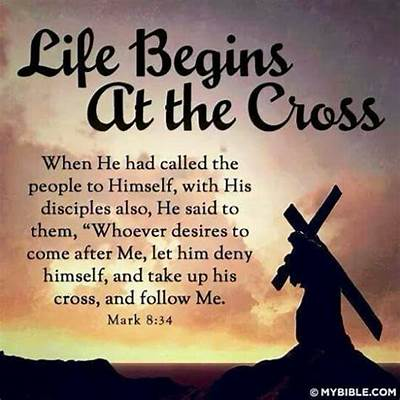
“A certain man from Cyrene, Simon, the father of Alexander and Rufus, was passing by on his way in from the country, and they forced him to carry the cross.”

Mark 15:21 (NIV)

Sometimes it seems like our plans get hijacked by random events which are outside of our control. That’s how Simon, the Cyrene felt. As a Jewish husband and father, he had big plans to travel to Jerusalem with his family to enjoy the Passover holiday. He was from a city in North Africa, which today is located in the country of Libya. While Simon was in Jerusalem, he saw crowds of people lining the streets to see a procession of a condemned criminal carrying his cross.

While watching the scene as a bystander, Simon was suddenly pulled from the crowd, and compelled by Roman soldiers to carry the criminal’s cross. He didn’t even know who Jesus was at the time and probably pleaded with the soldiers, saying that he had nothing to do with him.

All his plans for a pleasant vacation fell apart as he was forced to carry a heavy cross and walk beside a condemned criminal he didn’t even know. 

Roman law required that sentenced criminals carry their own crosses, but Jesus was weak, having lost a lot of blood from the beatings, so that He could barely walk, much less carry a cross. When Simon was pulled from that crowd, it looked like he was randomly selected, but nothing is random with God.

In the time it took for Simon to carry the cross up the hill of Golgotha, he actually had a closer view of Jesus’ suffering, than anyone else had. He saw every bloody wound that covered His body from head to toe. In those physically close moments, Simon locked eyes with Jesus, not knowing anything about Him or the charges brought against Him. Yet, he knew he was not looking at the face of a criminal. What first seemed like being at the wrong place, at the wrong time, became a life changing walk with his Messiah and Savior. 

Matthew, Mark and Luke all wrote about Simon, the Cyrene, in their gospels years later, describing him as the father of Alexander and Rufus, which indicates that they came to know him and his family. Scripture leaves hints that Simon and his family later became part of the early Christian church in Rome.  The apostle Paul also wrote about Simon’s son Rufus, as being “chosen in the Lord”, along with his mother, as faithful servants of God. 

(Romans 16:13) 

What seemed like a random act of misfortune, ruining Simon’s Passover plans, had a special and divine purpose afterall. He brought his family to Jerusalem at the most popular time of the year, to find their Passover lamb, and instead, they found their Savior, the Passover Lamb of God. Although, no more is mentioned in scripture about Simon, it’s obvious that his close walk with Jesus, changed his life and his family’s lives forever. 

We may have days like Simon’s, when some unpleasant and random event, later turns out to be a new path that God was leading us to all along. No profound words were spoken to Simon, and he witnessed no miracles. He simply walked beside Jesus, but looking in His eyes,  his life took a whole new direction. 

We can learn through Simon, the Cyrene, that when it seems like a random event or person has ruined our plans, there might be a better plan that God is leading us to.

All we need to do is keep walking  beside Jesus in His resurrection power. As we take quiet moments to gaze into His eyes, His presence lightens our burdens and empowers us to go with the flow of unexpected and random events. God always has our best interests in mind, bringing us to the right place at the right time,  opening up new paths for us to follow.

Lord, we choose to keep walking beside you, and to trust that nothing is random, and you are guiding our lives every single day. We know that we can do all things through Christ who strengthens us. Amen

Ways to love

“Children, let us love not in word or speech but in deed and truth.”

1 John 3:18 (NAB)

Jesus reminded everyone to back their words up with deeds and acts of kindness. For one person, words mean everything, while for another person, physical touch means more than words. Others just ask for acts of service. 

According to the book based on the theory of “Love languages,” every person has a preferred way to give and receive love. 

There are supposedly five total love languages. They may be words of affirmation, physical touch, acts of service, gift giving, or spending quality time. Every person is born with a natural inclination for showing or interpreting love in a particular way. 

I once attended a Love language seminar at my church, and afterward I wondered what love language Jesus has. Since He was present at every person’s creation, I believe His love language is all five. He put the specific language of love within each person and therefore He is able to receive it, in whichever way we best express it.

Anyone who has ever been a caregiver for a loved one, has expressed physical touch and acts of service every day that they cared for their loved one. Those two love languages alone are used by all caregivers. 

Quality time and words of affirmation are so helpful in any relationship. I regret not deliberately giving more words of affirmation and spending more quality time with my husband during his illness. Taking care of a sick person requires constant acts of service, so it’s easy to be busy serving, and forget to slow down and spend some quality time together. Likewise, words of affirmation always seem to escape the key moment, so they are easier said spontaneously, rather than planned.

Quality time, however, did come to my husband from his friends and family, who visited him regularly. That meant the world to him to have his friends and family visit him every weekend, as I served snack foods, while they hung out with him, watching the golf channel. Those visits of quality time, were a special gift to him in his condition. I am thankful for the friends and family who took time to regularly visit him. 

When I cared for my mother in the last year of her life, she loved music, so I used to play music from her era, for her to enjoy. One day I just spontaneously started dancing to her music, and she just lit up with joy, clapping and encouraging me on. Those were special moments of joy with her. Still, with both my husband and my mother, I regret not expressing more words of affirmation at the time, but there never seemed to be the right time, or enough of it.

I remember when the two doctors I worked with came to my late husband’s visitation, even though they never knew him. Just seeing them show up, surprised me and warmed my heart, knowing they were there for me. Another doctor who I worked with, couldn’t make it to the wake, but the next day, he showed up at my front door with a blueberry pie in his hands. He heard from someone that I liked blueberry pie. My heart just melted.

Those are spontaneous acts of kindness that will stay with me forever. Who knows what deed of love we have already done for someone, or what we’ll do or say today that will stay in someone’s heart forever. Whether it’s through deeds, words, quality time, physical touch, or gift giving, lovingkindness in any form, received in truth, changes a heart and a life forever.

Lord, thank you for being the author of all love languages and every  expression of kindness. Thank you for those who bless our lives and help us to know the best way to express love to others. Amen

Kingdom living

“Asked by the Pharisees when the kingdom of God would come, he said in reply, “The coming of the kingdom of God cannot be observed, and no one will announce, ‘Look, here it is,’ or, ‘There it is.’ For behold, the kingdom of God is among you.”

Luke 17:20-21 (NIV)

In this scripture, Jesus was not talking about the place of Heaven. He was talking about the kingdom of God, which cannot be observed visually because it’s not a place, it’s a lifestyle. Kingdom living is living in a personal relationship with a king, specifically the King of all kings, who is Jesus. 

There is a difference between the observance of religious rules and having a relationship with the Lord. In any kind of relationship, the bond between two people is not based on following rules, but on love for one another. I think that churches have probably lost members over time, because Christian teaching tends to be reduced to a system of rules, instead of a relationship of love with the Lord. 

Jesus’ words to the church in the book of Revelation says it all, 

“I have this against you, that you have left your first love.” Jesus just wants to be our first love. 

(Revelation 2:4)

God sure seems more interested in a relationship with us than in rules. 

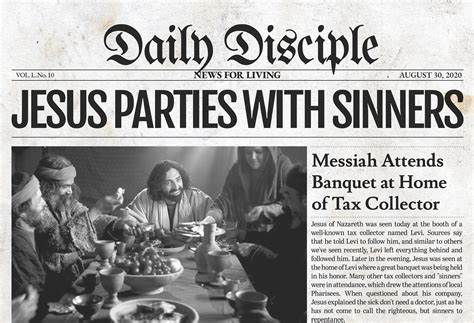
The gospels repeatedly show examples where Jesus was not impressed with the most religious rule followers of His time, especially since He was often accused of breaking rules and hanging out with the outcasts. Kingdom living means doing as Jesus did and being led by compassion, even if it means befriending people who live a totally different lifestyle. Kingdom living leads to placing relationships over rules. 

Speaking of rules vs. relationships, I just received a disappointing notice that it is now against the rule for me to bring any kind of edible treats to residents at the Nursing Facility. I used to share treats with them at each visit, since most residents are lonely and never have visitors at all. 

No specific incident occurred to cause this, but there is a new Director who seems wholeheartedly convinced that rules are more important than the joy and dignity residents get in receiving treats. 

Kingdom living requires us to adapt to unpleasant changes in our lives, but instead of resisting, it helps to consider that God might be telling us something through those changes. Whether it involves difficult managers on the job, or a strict director of a Nursing facility, dealing with disappointment is also part of kingdom living. When Jesus dealt with it, He prayed and looked to His Father, seeking His will, not His own. Maybe God is trying to teach us something while we adjust to certain unpleasant changes happening around us, so that we will pray for God’s wisdom.

Kingdom living requires looking for a new approach to show kindness toward the residents, since I will continue to visit them, but no longer bring treats. So thankfully, there are no rules against showing kindness to residents in other ways.

Sometimes medical professionals forget that a Nursing Home patient is more than another human body to medically care for, but a soul made in the image of God, and deserving of dignity. 

Lord, help us to find our place in kingdom living, and to show love, dignity and compassion to those who feel forgotten, and give us the grace to forgive our enemies and to learn what God is teaching us through unpleasant changes. Amen

Sunday school moments

“And he said: “Truly I tell you, unless you change and become like little children, you will never enter the kingdom of heaven.”

Matthew 18:3 (NIV)

One day last week, a Jewish resident at the Nursing Facility was talking about Mikva baths, and their ritual uses for cleansing according to Jewish religious laws. I immediately thought of the story in the gospel of the woman with the hemorrhage, who would have been required by Jewish law to be cleansed by a Mikva bath. 

I turned to a resident sitting beside me, who I’ve become friends with and knowing she believes in Jesus, I told her that the Mikva bath reminds me of that particular gospel story. I wasn’t sure if she knew that story, so I shifted into my Sunday school teacher mode. Even though it’s been 40 years since I taught Sunday school, I still enjoy telling any of those stories from the Bible. 

The resident, who I will call Jan, for privacy reasons, will be 75 years old this month, but she listened to the story just as a child would. When I got to the part of how the woman crawled through the crowd, just to touch the fringe of Jesus’ garment, I paused to ask the Jewish resident what the fringe part of a Jewish prayer shawl is called, and he said that it’s called “Tzitzit.” 

So I continued telling the story to Jan of how the woman merely touched the “Tzitzit” of Jesus’ prayer shawl, and her bleeding immediately stopped as she was miraculously healed. Then Jesus stopped walking and asked “Who touched Me?” With a large crowd all around Him, the disciples said “Lord, so many are touching you”, but Jesus said, “No, I just felt power coming out of Me.” 

While telling that part of the story, Jan looked at me as she listened with a sense of awe. As her eyes widened with amazement, she suddenly burst out loud, saying 

“I love Jesus!” 

That’s what I call a Sunday school moment, when a Bible story touches a heart with such amazement, as it would do for a child in a Sunday school class. Jan’s excited response sparked a flame within me and I could feel her childlike excitement. I readily agreed with her, saying,

“Me too!”

Jan is not a child, but she received a gospel story with the heart of a child, as Jesus described in today’s scripture. She was as excited as if she were right there watching it all first hand. Her heart was set on fire by a story about Jesus and in all of her enthusiasm, she lit my heart on fire as well. 

While driving home and thinking about that Sunday school moment, I couldn’t stop smiling. Jesus told us to change and become like a child, and He meant that for believers of all ages, despite how much we already know. Jan’s spontaneous childlike response lit a flame in my heart and something changed in me at that moment. That’s what we are all meant to do for one another.

Having the heart of a child means there is always something new to learn about Jesus, always a yearning for more of His presence, and a fire to keep burning in our hearts for Him.  

Sunday school moments are not only inspired by stories in the bible. They could be real life stories of people we know or meet each day. We might hear stories from people who received a miracle, a long waited answer to prayer, or a faith inspiring experience with Jesus. We become like a child whenever we light the fire of wonder and awe in someone else’s heart or they light ours. 

Lord, keep the fire burning in our hearts so that we will always find excitement to learn and yearn for more of you. Amen

What Jesus loves

“Jesus looked at them and said, With man this is impossible, but with God all things are possible.”

Matthew 19:26 (NIV)

All my Christian life, I’ve heard a small voice whispering within my spirit, telling me to ask for bigger things from God. That whisper was not a verbal message but something I felt within. It all began during my early twenties, when a gifted and prayerful senior lady in my church came up to me one day and said, “The Lord told me to tell you to ask big of Him.” 

At first I thought it was a strange thing to say, but that lady had a lot of wisdom as well as an amazing sensitivity to the Holy Spirit, not to mention that her message was compatible with scripture. I thought to myself, maybe I have a tendency to limit my faith in what God can do. 

Time passes, life gets busy and I often forget about that day, but the Lord reminds me by something said through a friend, a book, radio or TV show. God wants all of us to keep asking big of Him. 

In all the gospel stories, Jesus reacted so positively to any person who came to Him, asking for the miraculous.

The woman who once crawled through a crowd to touch Jesus’ garment wasn’t discouraged by all the years that she suffered with her ailment. She believed that this was her moment to ask big of God, and she was healed after one touch, and Jesus loved it.

The gentile woman who begged Jesus to heal her daughter, never let her gentile status inhibit her from asking the Jewish Messiah to heal her sick daughter. Then He tested her faith by telling her that she wasn’t one of His people, but she never backed down, and persisted in asking for her miracle, and her daughter was healed. Jesus loved her persistence.

The Roman Centurion told Jesus that if He would only say the word, his servant would be healed. He didn’t ask Jesus to come and lay His hands on the dying man, but only to “say the word.” He asked for a big miracle, his servant was healed, and Jesus loved his faith.

In all His parables and stories about prayer to God, Jesus encourages persistence in asking, even when dealing with unjust people or corrupt judges. According to Him, knocking, seeking and asking, wins in the end, because asking big of God, is what Jesus loves. 

In Jesus’ own words, all things are possible with God. That means it’s possible to change the composition of our body cells, to make tumors disappear, to restore a heart rhythm, to rejuvenate weak and atrophied muscles, and to heal a brain and other mental disorders. 

Jesus is in the business of doing the impossible, and He is not only able, but willing, based on His words to the blind men, saying, “I am willing, be healed.”(Luke 5:13) He is the same today as He was yesterday so we can dream bigger, and trust Him for the impossible. 

It’s time to visualize the biggest request we could ever ask or pray for, no matter how long we have waited for it. It pleases Jesus when we ask for the big things. We can never ask anything too big, since faith in Him makes Him happy. 

“Without faith, it is impossible to please God.” (Hebrews 11:6)

Lord, we touch the edge of your garment today, asking you to only say the word, and we thank you for the grace of faith to believe in a bigger way than we ever have before. Amen

Come Holy Spirit

“Rejoice always, pray constantly, give thanks in all circumstances; for this is the will of God in Christ Jesus for you.

1 Thessalonians 5:16-18 (RSV)

Paul tells us to always rejoice and always give thanks, but the real key message in this scripture is to pray constantly. It’s much easier to rejoice and be thankful when we have assurance that God hears us when we pray. 

I was wondering what he means by praying constantly. Most equate prayer to looking at a prayer list, and asking God for all the pressing needs in our lives, our friends’ lives and our family’s lives. People have their own style and formats of prayer, and all prayer is good, but sometimes later in the day, frustrating situations arise that are very unsettling, and we need more prayer, which is probably why Paul tells us to pray constantly.

On days like that, I suspect that we often miss out by thinking prayer is a lengthy, formal way to talk to God, but there is one short and simple prayer that we can pray constantly throughout every day, which is, “Come Holy Spirit.” Those three words, said with sincerity, are transformative words of power. 

If we ask the Holy Spirit to come, He always shows up, because He is faithful. In fact, I have discovered that not praying that prayer, is what is missing in a day that seems to be filled with aggravation.

Some days I feel that I have nothing to write, like a writers block, with no ideas for the next meditation, but when I pray “Come Holy Spirit,” He always comes through, and gives me a message to share. It might happen through an inspiring event during the day, or reading a familiar scripture with some new meaning, or through something heard through a media source like TV or radio. 

Something definitely happens when I pray that simple prayer. It’s as if He becomes activated and goes right to work, to inspire the next meditation. The Holy Spirit comes through 100% of the time because that three word prayer brings the power we need in the moment, whether it’s patience, direction, or wisdom. He is our gift from Heaven just as Jesus promised.

The Spirit dwells in every believer, but He always behaves like a gentleman, until He is called upon. He remains quietly within each person, never forcing His will on us, but waits patiently to be invited into our situation. When we call upon Him by saying “Come Holy Spirit,” we will notice the day is different in a good way, since He’s been welcomed into our lives.

The message is simple, praying constantly can simply mean asking the third person of the Trinity, throughout our day, to “Come”. 

Jesus told us that He is sending us a Helper, who will reveal all truth, to guide and comfort us, by pouring new hope into our hearts when we need it most.

This week we celebrate Pentecost Sunday, the day that God first sent His Spirit down to men and women in a powerful and dramatic way. That first day of Pentecost came as a gift from Heaven, wrapped in a loud, rushing wind, and topped with bows of flaming fire. The same Spirit is in us today, dwelling as a gentle dove, with a quiet whisper instead of a loud wind, and He politely waits for us to invite him into each of our life situations. We activate Him by asking Him to “Come.”


Lord, thank you for the gift of your Holy Spirit who is in us and waiting to be actively involved in every part of our day. We invite you to transform our hearts, our minds and the events of our day as we pray constantly, “Come Holy Spirit.” Amen

Disclosure of a heart

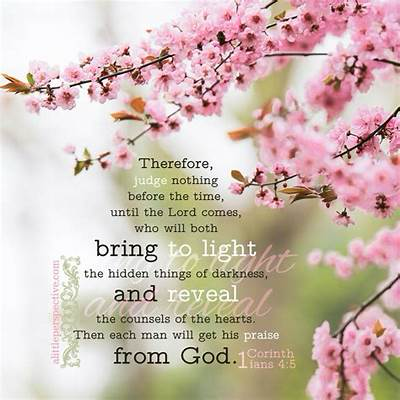
“Therefore do not pronounce judgment before the time, before the Lord comes, who will bring to light the things now hidden in darkness and will disclose the purposes of the heart. Then each one will receive commendation from God.”

1 Corinthians 4:5 (RSV)


An author once wrote a book about the first wave of Mexican immigrants to Chicago in 1917. The stories of those immigrants who first settled in Chicago were collected from various sources. One of those sources was a young Mexican woman who kept a hand written diary documenting her family’s history, faith in God, and their effort to leave the turmoil of the Mexican revolution at the time. Her name was Elidia Barroso and she was my late husband’s aunt. 

As I read excerpts from Elidia’s diary in the book, I started to piece together the traumatic events that affected their youngest brother more than anyone else. The Spanish flu pandemic at the time, was taking millions of lives globally, and it took the lives of Elidia’s mother and father. She became the responsible oldest sister of four orphaned children in Mexico. Elidia and her two sisters migrated to America in search of work to support themselves and their little brother, Peter, who was only six years old at the time. 

Elidia and her sisters didn’t encounter Customs and Border patrol in those days, since the organization wasn’t created until 1924. Mexicans only needed to pass a literacy test and pay the eight dollar head tax, to enter the United States.

With both parents dead, the older sisters dropped Peter off at the home of a distant relative in Texas, as the three girls migrated to Chicago to search for work. Peter’s life went from a happy, carefree childhood, living with his family on a ranch in Mexico, to becoming a scared and confused orphan, living in a new country, learning a new language with relatives he hardly knew.  

He was later reunited with his older sisters in Chicago, who raised him to adulthood. He eventually outlived his sisters, married and had a family of his own. He was not an easy person for his own three sons to understand, since he never talked about his childhood of loss and separation. His sons only knew their father as a harsh, abrasive and complex man. His middle son was my late husband, Stephen. I never met Peter, his father, since he died before we married.

Only God knows what pain people have hidden in the dark corners of their life. The scripture today warns us not to pronounce judgement before the time, that only God can bring to light the things hidden in the darkness. 

It was Elidia Barroso’s diary, which brought out what was previously unknown about Peter’s traumatic childhood, which shed much light on his complex personality as a father.

Today, whenever I am tempted to judge somebody, I think of Peter, the scared, lonely child who lost both his parents and was separated from his sisters at the age of six, and how a disrupted childhood may affect a life.

If we could see every person in the light of their personal struggles or through the eyes of an all knowing God, we would probably never judge anyone again. God brings to light the things hidden in the darkness, sometimes disclosing what is really in a person’s heart. Having a brief glimpse of the pain and loneliness in someone’s life, gives us the eyes of mercy to better understand who that person really is. 

Lord, enlighten our minds and give us a heart of mercy toward those who we tend to misjudge today. Give us the light of understanding so we may see people through your eyes. Amen

Sustained in old age

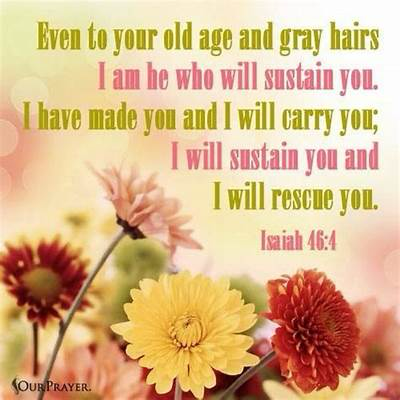
“Even to your old age and gray hairs

I am He, I am He who will sustain you. I have made you and I will carry you; I will sustain you and I will rescue you.”

Isaiah 46:4 (NIV)

This is one of the few scriptures written for senior citizens. There is another one in Psalms that refers to the average human life span as a “handbreath”, which is an ancient Hebrew measurement of about 3 inches. Not only is it referred to in brief inches, but it says that every human life is like a fleeting breath to God. We may differentiate between long lives, short lives, and babies who are just beginning to live their lives, but to God, all physical life is a fleeting breath, since each real life is the soul who will live forever. 

Last weekend, I celebrated a very old life and a very young life, two days in a row. I sang Happy birthday to a 92 year old friend on one day and the next day, I sang it to my 1 year old great, great niece. The paper plates and napkins at the one year old’s party, cleverly read, “First trip around the sun.” 

Whether we’ve had one trip around the sun or ninety two, every day of life is a gift from God. The average life span in the US went up last year, and is now 79, but since some people still live to their nineties, it’s good to learn what researchers found about those who are living longer. 

Time magazine once published an article about a research study, concluding that those who regularly attend any type of religious service have decreased stress and live longer than average life spans.

The reason for this wasn’t the effect of prayer alone, but prayer plus the regular support of a faith community. 

The value of congregating with like minded people of faith, is what a Harvard professor of epidemiology, found in doing this study. Having a network of social support as well as a deep sense of purpose in life, accounted for longevity benefits among those he studied. Scripture suggested this 2,000 years ago, encouraging believers to live as one unified supportive community of faith, so Christianity actually taught this long before Harvard discovered it.

Jesus left us the Holy Spirit after He ascended to heaven. The book of Acts described the lifestyle that believers in the early Spirit filled church were living. They were described as devoted to the apostles’ teaching, to regular fellowship, to the breaking of bread and to prayer. (Acts 2:42)

Their church life was a community of mutual support, and they all had a deep purpose in living for Jesus, believing He was returning again one day.

Living a long life as we know it, is still a mere fleeting breath to God. Senior living has to be about more than healthy eating, exercise, efforts in looking younger and saving money. God told us through Isaiah, that even in our old age, when our hair is gray, He will sustain us. His sustenance extends beyond finding the right wrinkle creams, nutritional tips or hair dyes. 

As we age, although we may encounter increased health, financial, or relationship problems in our senior years, we have been given a beautiful promise that God will sustain us, rescue us and carry us throughout those years. He does it as we depend solely on Him as our source, and plug ourselves into a community of like minded believers, where we share spiritual and emotional support. This is what benefits our recoveries from illness and alleviates stress. 

God is good, and living life with the knowledge of His goodness, we find that He does rescue us from our afflictions and carry us when we need to be carried. Refocusing our values on a life being well lived, instead of dwelling on our losses, keeps us making those trips around the sun year after year. 

I can still remember sitting on my own grandmother’s lap as a child, and though I saw the wrinkles on her face and her coarse, gray hair, what I looked for most was her smile, her joyful laugh and the sparkle in her eyes that made me feel like I was a delight in her life. The way that grandchildren, great nieces or great nephews see us is one more gift of God’s sustenance through our gray haired years. 

Lord, thank you for sustaining, rescuing and carrying us through the many phases of aging, and help us to stay strong in a community of faith and Christ centered purpose during all our trips around the sun. Amen

Layers of history

“Therefore judge nothing before the appointed time; wait until the Lord comes. He will bring to light what is hidden in darkness and will expose the motives of the heart. At that time each will receive their praise from God.”

1 Corinthians 4:5 (NIV)

The Holy land is an archeologist’s haven, with ground that is layered in history. Buried under that ground are treasures of historic evidence and artifacts of many victories, defeats, miraculous sustenance of God for His people as well as the sorrow of conquests by their enemies. The stories are all there, buried in layers beneath the ground.

A Jewish couple, the Seibenbergs,  fled from Belgium during the Holocaust, and eventually moved to Israel. They bought a house in one of the oldest quarters of Jerusalem. Later they discovered that beneath their home were layers of history, with artifacts that dated back three thousands years, as far back as King Solomon. 

After years of excavation, one layer beneath their home was found to  contain the remains of a Maccabean palace, which is where the miracle story of Hanukkah first originated. The Siebenberg house is a public museum today, displaying ancient artifacts of jewelry, pottery, artwork and coins, found buried in layers of history. 

As I read about the layers of history found in the city of Jerusalem alone, 

I thought of how archeology tells a story of what was once buried and  hidden. Each one of us is a living, breathing excavation project, composed of layers of our own history and experiences, which makes us who we are today. 

We each have our own story, of events and relationships that we experienced through different stages of our lives, and we are still adding to our history. We have stories buried in layers of history, during our times of victory, defeat, the miraculous intervention of God and our battles with spiritual enemies. 

God has been with us in every stage of that history, loving, guiding and forming us into who we are. Jesus will head the excavation project that will reveal the treasures that are in our past as well as those that continue, while we are living. 

The full effect of every good or kind deed we have ever done in our lifetime, will be excavated and revealed at the end of time. The true impact of how any person might have been inspired by another person, for the glory of God, or for the salvation of souls, will all one day be revealed by the excavation project headed by Jesus. 

Jerusalem is a city where history comes alive because of continuous excavation projects. We are children of the Lord of excavation. We add layers of history every day to our lives as we walk with Christ, and abide in Him, until the day that our buried treasures are brought to His light. 

Lord,  we praise you for being the Lord of all that is to be excavated in us, one day. Help us to make the history of our lives something beautiful as your light shines on us and through us always. Amen

Counting the cost

“Which of you wishing to construct a tower does not first sit down and calculate the cost to see if there is enough for its completion?

Otherwise, after laying the foundation and finding himself unable to finish the work the onlookers should laugh at him and say, ‘This one began to build but did not have the resources to finish.”

Luke 14:28-30 (NAB)

Twice in one day, within two hours, a person in line ahead of me canceled and backed out of a transaction. The first time was at a grocery store, when the couple in line ahead of me, gasped at the price of Bing cherries, which were $11.00/lb. They canceled their transaction and walked out, and I didn’t blame them. 

After that, I went to a drive thru car wash, and while waiting in line, the car in front of me drove partially into the wash but then stopped short of advancing forward enough to trigger the wash to start. After waiting a minute, I walked to the car to see why it stopped, and the young woman driver thought the car wash wasn’t working. I suggested that she drive forward, enough for the wash to start. 

The attendant came out and told her the same thing, but she wanted to cancel the wash and get her refund. 

I suspected she was embarrassed in holding up the line, because of a misunderstanding of how to drive through a car wash.

It seemed strange that twice within a short span of time, I encountered people who canceled a transaction for one reason or another. There could be a message in those two incidents, with the theme of the day being  “counting the cost.”

Whether it was counting the high cost of Bing cherries or the half hearted decision to proceed through an unfamiliar car wash, each person re-considered, canceled their transaction and left.

Jesus once counted the cost of what was required to become our Savior. He first counted it from heaven before willingly entering this world as a man. He counted the cost one last time, in those stressful, but defining moments in the Gethsemane garden. He felt fear and every emotion that a human being can feel, and asked His Father if He could possibly pass on the whole thing. He counted the cost, but in the end, He consented. 

It was in the Garden where Jesus  decided that each one of us were worth the high price He paid for our redemption. He chose to proceed, not cancel, change His mind, or walk away, but rather to finish the work at the cross, by putting His whole heart into it. Because He loved us, He considered us worth it, for Him to proceed in carrying His cross.

God desires to conform everyone who believes, into the image of His son, and Jesus longs to make us His disciples. As we count the cost of discipleship, we realize that we all have a cross of some kind to carry. 

(Romans 8:29) 

Jesus said, “Whoever does not carry his own cross and follow me cannot be my disciple.” Those are clear and straightforward words. Carrying our cross comes after counting the cost, just as Jesus did in that Garden. Mary, His mother, also counted the cost of becoming the mother of the Messiah who would suffer in a harsh world, but she too, said yes.

In reality, we are living in a fallen world. We don’t soar through life with a “name it, claim it, instantly gratifying, problem free faith or lifestyle.” Painful trials happen to believers and unbelievers alike, but as believers, we get to know our Savior, and develop a friendship with Him. Through faith, we come to learn that something good always comes out of our pain. 

Nothing that we have ever suffered is wasted. In all suffering, there is meaning and comfort in knowing Jesus already suffered the same thing and knows exactly how we feel. We also find purpose in suffering by being able to comfort others who go through something similar. The Lord’s church is a community of His sons and daughters, who share the compassion of Christ with each other and with the world. 

We may never fully understand every purpose in this present lifetime, but we know that God is constantly conforming us to the image of Christ. We might be better off to ask, “Lord, reveal your purpose for me through this trial,” instead of “Lord, remove this problem from me,” so that we can find peace in the purpose. 

While we go through any pain or sorrow, we count the cost, as we choose to take up our cross and follow Jesus another day. Knowing He has the best plan for us, we carry our cross and follow Him, because that’s what disciples do. 

It’s a lesson we’ll be learning all throughout our lives, and at times, my soul needs to catch up with the words I write, but we can put our trust in this scriptural truth, 

“We know that God causes all things to work together for good to those who love God, to those who are called according to His purpose.”

(Romans 8:28)

Lord, we thank you for counting us worthy of the cost you paid for our salvation, and help us to carry our own cross, while we are being conformed to your image, to better reflect your love to the world. Amen