Jesus, Lord of today

“Therefore do not worry about tomorrow, for tomorrow will worry about itself. Each day has enough trouble of its own.”

Matthew 6:34 (NIV)

Jesus said each day has enough trouble of its own, and He doesn’t advise us to get caught up in worry about the future or to grieve too long over past sorrows or offenses. It will only compound the problems of today. He knows what we went through in our past, and He understands what we worry about in our future, but He has something special for us to receive today. Worrying about a future situation leads to anxiety, and dwelling on the past can lead to depression. In this scripture, Jesus tells us that each day has enough problems of it’s own, and His advice is to live in the present, not the past or the future. He said in the Lord’s Prayer, to ask God for our daily bread, which has been God’s message all along, going back to the days of Moses, when the manna fell from heaven each day. Manna, the heavenly bread, could only be gathered fresh each day. It couldn’t be collected and saved for the future or it would quickly rot. God is trying to keep us living in the present, for the sake of our mental and spiritual health. He is teaching this message to us not only through the manna from heaven story, but also in the story of the widow of Zarephath. After she gave the last of her flour and oil to feed the prophet Elijah, she received an endless supply of flour and oil in her jars, for days afterward. She received it fresh each day, not in a lump sum. God supplied her needs during a major drought and famine, but He did it one day at a time. It seems clear that God is trying to tell us through these stories, that He intends to give us all the help we need, but only one day at a time. Living in the present sounds hard to do, but it’s God’s prescription for our peace of mind. Jesus is teaching us to take this day’s concerns, and bring them to Him. Then we are to do the same thing tomorrow, and repeat the next day, and so on.  Each day can only care for its own problems, so He wants us to gather from Him fresh each day, just like the manna from heaven. Jesus called Himself the bread of heaven, and He is our daily bread, meaning we receive what He has for us fresh each day. Like the widow of Zarephath, our jars will be refilled, one day at a time. What He wants to give us today is different from yesterday, and it’s not the same as what He has for us tomorrow. It’s time to live in the present, and to raise our expectations as we arise each morning, and see what He has for us today. Jesus, you are the Lord of today, we surrender all worry and anxiety to you, casting all our cares upon you. We expect with open hearts to receive something special from you, as a sign of your daily Presence and your love that is with us now and throughout this day. Amen

Mercy without excuses

For judgment is without mercy to one who has shown no mercy; yet mercy triumphs over judgment.”

James 2:13 (RSV)

Mercy is the most unusual gift, it is both awesome and frightening. It’s awesome because it’s given freely to all of us who are undeserving. As freely as we receive it, we are expected to show mercy to that person we know who is also very undeserving. Its easy to show mercy to someone who we genuinely like, or feel true pity and compassion for. It’s the hardest virtue to live out, when we come up against a person who mistreats or betrays us, or hurts our loved ones, for no reason. Jesus spoke about mercy, not only in parables like the Good Samaritan, the merciful master and unmerciful servants, but He mentions it in the beatitudes sermon, “Blessed are the merciful, for they shall receive mercy”. When we stop to think about it, receiving mercy or showing mercy leads to eternal consequences. It’s a very real issue for the day of judgement. We are invited to freely receive His mercy to be saved, and we also need to show it to others, or we are accountable to God on that day. If there has ever been a person who didn’t deserve your kindness, but you showed it anyway, that is mercy. Mercy is the first lesson we experience in life. Without mercy, we are born as cold, helpless, naked and hungry infants. It’s the mercy of God that we are nurtured, fed, clothed and loved by at least one or two parents. As we grow in the faith, mercy is the best kept secret of Satan. He doesn’t want humanity to know how great God’s mercy can be, because we would then discover how much He really loves us. Instead of surrendering our lives to a merciful God, Satan would rather see us live a defeated life with unresolved guilt and feelings of unworthiness. Satan doesn’t mind that we regularly attend church, as long as we refuse to receive the fulness of God’s mercy or to show mercy to others. A death bed conversion is mercy at its highest power, forgiving the undeserving of all sin just before their death. While Jesus was forgiving one thief on the cross, He never answered the other one, who was cursing Him the whole time. God pours out His mercy and love to all people, but He searches the earth for anyone who will receive it, like the thief on the cross did. Mercy does triumph over judgement and it snatches souls before they head straight for the flames of hell. After we receive His mercy, Jesus simply desires that we show it to others. Every father wants his children to reflect his traits and mercy is how we show that we are children of our Father in heaven. If mercy means that much to Jesus, let’s pray to have more of it. Lord, thank you for your boundless mercy that searches in the world’s darkest places to find the cold, wretched blind and naked souls to save. Grant that we, who have received your mercy, can show your mercy to others.

Listening for your cue

“But when the Counselor comes, whom I shall send to you from the Father, even the Spirit of truth, who proceeds from the Father, he will bear witness to me;”

John 15:26 (RSV)

The Holy Spirit is so eager to bear witness to Christ, that He will literally change the topic of our conversations in order to bear witness to Him. Once in a while I pray, asking Him to make His presence known to everyone in a room with me, during my work day. 

If and whenever I remember to pray this way before I start my day, something always happens, and He never fails to step into the conversation, turning it around, to center it on Jesus. The great commission, where Jesus told believers to preach the gospel to every creature, is not a weight of responsibility on our shoulders, but simply about listening for our cue to say a few simple words at the right time. Bearing witness to Jesus is the Holy Spirit’s job, it’s His area of expertise, and I’ve seen how He takes over many conversations, and I just need to listen for my cue. If we speak when it’s our cue, the rest is in His divine hands.

If I’ve learned anything over the years in every job I’ve ever had, it’s that the HoIy Spirit is super eager to bear witness to Jesus. He is so eager that I can remember the few times and the most uncanny ways, that the Holy Spirit took over conversations, and Jesus suddenly became the topic. Even this week, a coworker was talking about aging and dying, and she just spontaneously said, “ I don’t want to die.” When I heard that, something sparked within me, because it was my cue. I said “No one wants to die, but dying is where we can meet Jesus face to face.” Her childlike statement “I don’t want to die” was the work of the Holy Spirit, stirring her heart, and He started that conversation. There was a seed to be planted, and praying for her will be the watering of the seed.

A week or two ago, a conversation with two others at work, strangely evolved into one about God and forgiveness. I wish I could recall how it even began, but someone was adamantly giving their opinion that mass murderers, tyrants or murderers of any kind, can never be forgiven and can never, ever go to heaven. I sensed my cue again and could only think of one thing to say. In a gentle way, I simply said, “but Jesus forgave His murderers from the cross.”

Though they didn’t accept my answer, it left them with an image of Jesus on a cross, forgiving the worst of men. What a blessing to have a segway into a conversation to present that image to people in the middle of a work day. I was filled with awe at the Holy Spirit’s way of coming into that conversation. God’s truth, when presented in kindness, will surely accomplish something later. We can plant seeds or water them, but only God causes the growth.

God’s mercy is too great for us to fully comprehend, and people put their own limitations on how far His grace and forgiveness will go, but it’s better to be at the mercy of God than at the mercy of men. The Holy Spirit is trying to reveal God’s mercy to all people every day, especially if He is invited into our day.

By asking Him to come into the room and make His presence know to others, He surprisingly will not disappoint, and it’s a powerful prayer.  He is so eager to bear witness to Jesus, and when He is invited, He stirs hearts and gives us the right words to say. Try it and see, and then simply listen for the cue. 

When God came down


“Then the Lord said, “I have seen the affliction of my people who are in Egypt, and have heard their cry because of their taskmasters; I know their sufferings, and I have come down to deliver them out of the hand of the Egyptians, and to bring them up out of that land to a good and broad land, a land flowing with milk and honey…”

Exodus 3:7-8 (RSV)

There have been two great exoduses that happened, and both exoduses began with God seeing and hearing the cries of His people who were in misery. God is Holy and omnipresent, yet in His compassion and love for us, He describes Himself as “coming down” to His people. He is tuned in to our every cry, and He sees everything that causes us misery. We may feel like He is far off and doesn’t hear us or see what we are suffering, and the Israelites felt the same way. They almost gave up hope that God was watching or hearing them in all their suffering in Egypt.

The word used in this scripture is misery, and other versions use the term oppression or affliction. God told Moses from the burning bush, He sees their misery, affliction and oppression and has come down to deliver them. This scripture should remind us of how God came down to us through the incarnation of Jesus. His coming down to us verifies the truth that God also sees us and hears us today when we cry out to Him.

In the first Passover that freed the Israelite slaves, it was the blood of an unblemished lamb, placed on every doorpost, which sign and signal to the death angel, to not strike that household, which trusted in the blood. God led them out of bondage and parted the sea for the people He loved all along.

Easter is the second, and final exodus, a fulfillment of the first one. God came down again to deliver us, only this time He provided the unblemished lamb Himself, giving us His only son, Jesus. He heard the cries and saw the misery of His people living under Roman oppression, and today He sees whatever sorrow or misery we go through, and He still comes down to us today.

After He divided the sea in the first exodus He provided bread from heaven to sustain them in the wilderness. In the second exodus, the thick temple curtain was supernaturally split open the moment Jesus died, which represents giving us an access to God through His sacrifice.

We are all journeying through a wilderness now, as the Israelites did, and God still sustains us. Since Jesus called Himself the bread of heaven, He is with us day by day, sustaining us through whatever wilderness experience we are going through. In His love and compassion, He hears and sees everything we suffer. Our destination and hope is to reach His promised land of heaven, instead of a geographical one as in the first exodus. The route to get there involves traveling through a wilderness just as in the first exodus.

His resurrection broke the power of sin and death, which has no power over us anymore. Instead of leading us with a pillar of cloud or fire, His Spirit dwells within us and leads us from within, as we journey onward. Jesus told us to ask anything in His name, because there is no other name given among mankind, by which we are saved. (Acts 4:12)

So after Easter, we continue on our journey to the promised land, with the shepherd of our souls leading us. We are the children of the second exodus. God is love, and He loves us so much that He “came down” to us through Jesus. We can trust His promise that He will never leave us or forsake us.

Lord, thank you for our exodus as we celebrate this Easter season of deliverance. As you lead us through the wilderness all the way to our promised land, please keep sustaining us one day at a time, on our journey with Jesus, who is our daily bread of heaven. Amen

A Resurrection message

“Early on the first day of the week, while it was still dark, Mary Magdalene went to the tomb and saw that the stone had been removed from the entrance.”

John 20:1 (NIV)

A day begins at sundown according to Jewish custom, which was  observed by Jesus and all Jewish people in His day. Every Jewish holiday is still based upon that system to this present day. The body of Jesus was wrapped in a special cloth, before sundown, with special spices and prayers according to the custom. The third day began at sundown Saturday. Mary Magdalene went to the tomb early Sunday morning, and panicked when His body was gone, leaving only that burial cloth. As we better understand Jewish burial customs of the first century, we can better appreciate the mysterious image on what is believed to be the burial cloth of Jesus, known as the shroud of Turin. There were traces of pollen in that cloth that are specific to that particular area of Palestine, which come from a flower that bloomed only in March or April. Coins were  placed on the eyes of the dead, to keep them closed and the coins imprinted on that shroud were dated to the era of Pontius Pilate. Scientists have agreed that the image is not hand made or painted. They cannot, however, explain what produced an image equivalent to a photographic negative, with 3-D qualities, long before photography was ever invented. An Italian sculptor, Luigi Enzo Mattei, was able to replicate a life size bronze statue of the body, taken from the mysterious image left on the shroud, shown in attached photos. Scientific analysis revealed that the body which produced that image was 5’10” and 173 lbs. His face looks peaceful, although battered, with a bump on the bridge of His nose, from swollen cartilage. His entire body has small dumbbell shaped imprints made from the attached end pieces of the Roman whip. The image on the cloth also had a stab wound on the side in the abdomen. There are holes in the feet and wrists, which fits with wounds of a crucifixion. Although many men were crucified under Roman rule, no others left a photo negative image on their burial cloth. This victim had head wounds made by thorns, but not from the crown of thorns we’ve seen in artwork over the centuries. It was more of a cap made of thorns. Isaiah described a Messiah who was marred more than any other man. By seeing this reconstructed life size body, which fits the description of Jesus, we can also envision the same body as He walked out of the tomb alive on Sunday morning. For a brief moment, try to personalize the resurrection of Jesus, imagining you, instead of Mary Magdalene, were the first one to arrive at the tomb. You look into the tomb and see only His burial cloth lying there. As you leave the empty tomb, you meet the risen Jesus, 5’10” tall, with nail scarred holes in His wrists and feet. His wounds are healed and He stands completely whole before you, no longer in pain. He is smiling, with beautiful love filled eyes, gazing down at you. He is wearing a clean, new white robe, which contrasts against His middle eastern tan complexion. He speaks to you in a smooth mellow voice, with words that fill your heart with a  comforting peace that is beyond explanation. There is an aura of holiness around Him and He is full of joy in His glorified, resurrected body. You bow before Him, overwhelmed in His presence, and He speaks softly. He has a personal message just for you. Let your imagination fill in the blank. What is Jesus saying to you?_____________________________

Lord Jesus, I pray you bless every reader today with the fullness of joy and peace that your glorious resurrection gives to us. Amen and Hallelujah! Happy Easter to all!

IMG_1529.jpeg

Gash on forehead, swollen eyes, cheekbones and bump on bridge of nose from trauma 

IMG_1538.jpeg

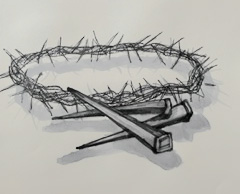
The cap of thorns

IMG_1545.jpeg

Holes in wrists and stab wound in the side

IMG_1537.jpeg

Holes in His feet from nails 

IMG_1535.jpeg

Small dumbbell shaped impressions in the legs from the scourging with the whip 

Inside Jerusalem

“O Lord, our Lord, how majestic is thy name in all the earth! Thou whose glory above the heavens is chanted by the mouth of babes and infants, thou hast founded a bulwark because of thy foes, to still the enemy and the avenger.”

Psalm 8:1-2 (RSV)

After Jesus entered Jerusalem, which was a very loud entry, filled with praise and Hosannas, He drew the attention of the entire city. Everyone was talking about Him, asking “Who is this?” Those who knew Him worshipped Him, and those who didn’t know Him came to learn more. The ones who already experienced His love and mercy in a personal way, shared their story with those who didn’t know Him. Some who learned about Him, still never knew Him, because their learning never transferred from their head to their heart. Those were the people who joined the crowd who later condemned Him. His first destination was entering His Father’s house, where He drove out the money changers, who defiled it, and cleansing His temple was His first priority during His final days in Jerusalem. Jesus wanted His temple to be a house of worship to glorify His Father. It is also where the blind and lame gathered from every part of the city, and some met Jesus for the first time in the temple area that day. Jesus healed them all, and they were probably the last to be healed during His earthly ministry. Among all those He healed, not all continued to follow and worship Him. We know this from the story of the ten lepers who were healed, but only one returned to praise and thank Him. He warned about the seed that would fall on rocky ground and not grow into a lasting faith, like those who first welcomed Him into Jerusalem but later condemned Him to be crucified. Then came the children singing Hosannas to Him, as was predicted by David’s Psalm, saying that out of the mouth of babes, God would bring forth praise for His son. When the chief priests became indignant at the noisy children, Jesus simply rebuked them for not knowing the scripture prophesying that little children would shout His praises. He reminded them of this scripture and for a brief moment His foes were silent with nothing to say. His entry into Jerusalem was a landmark day in history, because it marked a clear split between those who were with Him and those who were against Him.  Whatever the reason that so many betrayed Him, whether it was because of seeds in rocky ground, or people who never really knew Him, or due to religious pride, there was a great betrayal of Jesus, after entering Jerusalem that day. As we remember these events this Holy week, Jesus told us “No one takes My life from me, but I lay it down on my own.” (John 10:18) 

He entered inside Jerusalem, knowing His destiny, and He chose to lay His life down for us. He did it for the joy that was set before Him, and in His divine vision, He could see the lives that would be changed one day, like yours and mine. He saw the tears of repentance of every person who would kneel before Him and confess Him as Lord. He saw all the souls that would be ransomed and  join Him in heaven, and these visions of joy helped Him to endure the cross. As we go to His house during this Holy week, we allow Jesus to cleanse our temples by receiving His forgiveness. With a seed of faith planted deep in our hearts, we take the time to return to Him in some special way this week as that one leper returned to thank and praise Him. We offer the praise from our lips as the noisy little children did that day, and with childlike faith we are unconcerned with being accepted by anyone else but Him. Jesus laid it all down for us and we can also lay ourselves down before Him.  We are entering inside Jerusalem with Jesus this week and we are following His footsteps from the loud Hosannas to the silent painful road that led to the cross. At the cross, He bore our sins and paid for our punishment, making us whole. Take us with you Jesus, inside Jerusalem today and all week, and help us to draw closer to you and simply love you in a deeper way than ever before. Amen

The humanity of our Savior


“For we have not a high priest who is unable to sympathize with our weaknesses, but one who in every respect has been tempted as we are, yet without sin.”

Hebrews 4:15 (RSV)

It’s easy to say “I’m only human,”when I fail to follow the things Jesus taught me, but sometimes I forget that Jesus was human too. We focus on His divinity through the gospel stories and His miraculous ministry, but He had a human side which He lived out as a boy and a man for thirty years, before ever revealing His divinity. We have no recorded stories of miracles that Jesus performed until His ministry began at thirty years old, so what about those thirty years before He began His ministry? He probably lived a normal human life, since scripture tells us He was fully acquainted with all the tests and temptations of life, except He was without sin. He was perfectly sinless, but He still knew what it felt like to experience the emotional storms of temptation and testing that we do. He felt betrayal, disrespect and rejection from some of the very friends and relatives He knew and loved during those first thirty years of His life. He performed miracles, signs, and wonders as He accomplished His mission of salvation during the last three years of His life, but we seldom reflect on His humanity for the thirty years beforehand. His ministry consisted of the last 10% of His entire life. He was fully divine and fully human, but today I’m reflecting on the fact that He lived 90% of His life span in His humanity. Scripture tells us He was tested in all ways as we are, therefore He had His entire life to experience many types of tests and temptations, and yet He was without sin. He never retaliated against people, never lost His faith, and never sinned against God, His Father. He felt hurt, frustration and anger when He was scorned and mistreated, but He worked through everything and followed the will of God in every aspect of His early life as well as at the end of His life. His life’s purpose was not to punish or retaliate, but to spread the truth and love of God to others. He spoke the truth and then moved on to whoever would listen next. Jesus asks us to follow Him, and in our humanity we follow His humanity, with His grace to reach His higher goals for our lives. He calls us to imitate His obedience because He is available to help and intercede for us. He is not merely a sympathizer, but a veteran of all testing, trials and temptations. He knows what we struggle with and fully empathizes with us. God loves us so much that He clothed His Son in a human body to fully relate to us, and then gave us His Spirit to help us live for Him. This makes Jesus the best high priest intercessor we could ever ask for. The next time I fail or want to retreat saying, “I’m only human”, I will remind myself, so is my Savior and high priest. As we confess our sins, He removes them farther than we ever deserve. “He made Him who knew no sin to be sin in our behalf, so that we might become the righteousness of God in Him.”
(2 Corinthians 5:21) 

Jesus, thank you for both your humanity and your divinity. We love you and trust in you as our high priest and intercessor. 

Thick skin and thankful hearts


“Blessed are the merciful,

for they will be shown mercy.

Blessed are the clean of heart,for they will see God. Blessed are the peacemakers, for they will be called children of God. Blessed are they who are persecuted for the sake of righteousness, for theirs is the kingdom of heaven.”

Matthew 5:7-10. (NAB)

I have hanging on the wall in my living room, a beautifully framed manuscript of the fifth chapter of Matthew, which is the Beatitudes. It’s easier to have it hanging on my wall than to plant it in my heart for daily living.  I find that once I start obsessing over someone who offended me, it grows into a snowball effect and soon I find I’m sitting on a mountain of resentment.

Thicker skin and a thankful heart are the two essentials needed to pursue if I am to ever live as a Christian. The people we quickly bond with and admire are far fewer than the number of people we misunderstand or feel nothing in common with. Whether it is true within our churches or in the world, we are all going to encounter people we don’t understand, or maybe don’t even like. We are faced with the constant challenge of being merciful to those who offend us.

Thankfully, we were never commanded to like our neighbor, but we are commanded to love them. Loving them would require seeing people through God’s eyes, treating them with respect, and not being triggered by their offenses. We don’t have to bond with every person we interact with but we are to respond according to the beatitudes, instead of reacting in oversensitivity to our feelings. We may never understand some people but if we thicken our skin, we can still look for something to be thankful for, turning our focus to God, not on our feelings. If I first thicken my skin from being overly sensitive, it’s easier to look for things I am thankful for.

If we are being mistreated because of our faith, that’s a different story, and the beatitudes tell us to consider ourselves blessed, when suffering for the sake of righteousness. Paul tells us to resist sin even to the point of shedding blood. (Hebrews 12:4)

Lord, help us to be peacemakers, and to plant your beatitudes in our hearts by being thankful and merciful to those who offend us. Amen