Expect the extraordinary

“What Jesus did here in Cana of Galilee was the first of the signs through which he revealed his glory; and his disciples believed in him.”

John 2:11 (NIV)

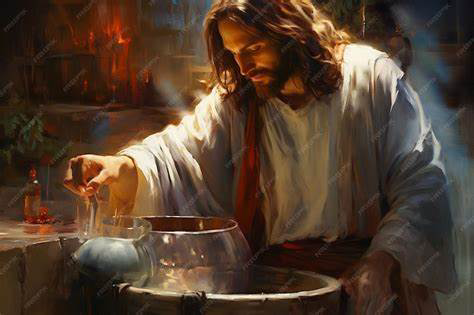
The bridal party was the platform used to first introduce Jesus as Messiah to the public. A crowd of wedding guests watched as He performed the first miracle of His ministry at the wedding in Cana. It all began with an embarrassing moment of running out of wine at a wedding reception. Jesus told the staff of waiters to fill all the large vessels with water and then He changed the water into wine.  

Commentaries on this section of scripture say that the total amount of wine in those vessels was about twenty to thirty gallons. Whether all the water  was changed instantly or it changed as it was drawn into pitchers, is not known for certain. What we do know, is that turning water into wine, was the miracle used to first introduce who Jesus really was. His disciples had no doubts once they saw with their eyes, common water turned into wine. 

I would have liked to know how He did it. I wonder if Jesus held His hand over the water in the vessels as Moses held his staff over the sea when it parted. Or did He speak to the water inside those vessels and command it to become wine, the way He spoke to the stormy sea and made it become calm. Maybe he just directed the waiters to draw the water out, and it became wine, in the same way He told Peter to recast his net into the sea, and it overflowed with fish. 

God does amazing things in and through water. Water is the most ordinary every day element, but when God manifests His glory over it, extraordinary things happen. The wine that Jesus made from water at that wedding, was extraordinarily high quality wine. It was so good that the head waiter questioned why it wasn’t served first. 

The water turning to wine was  symbolic of people who surrender themselves to God in faith. Every apostle that Jesus chose was an example of the ordinary becoming extraordinary. Peter wasn’t chosen because of his saintly nature. He was an ordinary man with an impulsive personality, a bad temper, and was intimidated by public opinion. When he was under pressure, being questioned, he denied knowing Jesus altogether.

In spite of Peter’s weaknesses, he had many gifts, which came out later as he was transformed into a bold, charismatic church leader and preacher. He led the early church with resilient faith, all the way to his own martyrdom. 

There were many other disciples who followed Peter with a similar transformation. Whatever faults we have, God can do anything in any person’s life, when they give Him their empty vessels to fill with wine as He chooses.

Whenever I used to read scripture, I would jot down notes in a journal, of what I thought God was saying to me. I kept these notes and read them from time to time, but never expected to ever share what I wrote with others. Until 2020, writing, for me, was a hidden treasure, discovered during my journey in the wilderness soon after becoming a widow.

Since then, I have been writing a scripture based meditation every morning, hoping to publish a book of meditations, after gathering fifty of my favorite ones. The title will be “Kissed by the Spirit; 50 days of comfort after loss.“ When I prayed about a name for my book, I woke up at 1 am with that title in my mind. For now, I place each day’s meditation on a website which is also called Kissedbythespirit.com

It seemed that during that period in my life, God turned water into wine. We are all like ordinary water, that is transformed, time and again, into quality wine, as often as we surrender ourselves to Jesus. We first need to offer Him our vessel of water, for Him to transform it into a vessel of wine. 

Jesus used wine as His first miracle because wine represents celebration and joy. Whatever sorrow we go through, He waits to restore our joy, once we surrender our vessel to Him. His joy is not a giddy shallow happiness, but a deep confidence within our soul that God loves us, is always with us, and restores our joy in the morning. When we live in that assurance, we will never again  remain ordinary. 

When we seek the purposes of God, He changes the ordinary into extraordinary. To Him who is able to accomplish far more than we could ever ask or imagine, by His power working within us, may He be glorified forever. 

(Ephesians 3:20-22)

Lord, we surrender ourselves to you, to transform our ordinary into extraordinary, changing us from water to wine, so that your power may work freely within us. Amen

Embracing silence

“He was oppressed, and he was afflicted,
yet he opened not his mouth;
like a lamb that is led to the slaughter,
and like a sheep that before its shearers is dumb,
so he opened not his mouth.”

Isaiah 53:7 (RSV)

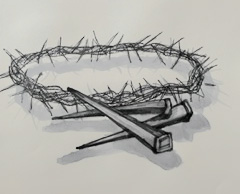
Isaiah described an afflicted, silent Messiah, whose mouth was closed. Jesus was very outspoken throughout His ministry, until His arrest. There’s a contrast between the Rabbi with a whip, who turned over the money changers’ tables, and the wounded Lamb of God, who carried His bloody cross up Golgotha’s hill. By example, Jesus showed us that there’s a time to speak out boldly and a time to be silent. 

He was silent at His arrest, except when Peter sprang into hero mode, and cut off someone’s ear. Jesus abruptly told him to put away the sword, saying,

“Don’t you think I can call upon my Father and he’ll provide me with more than twelve legions of angels?”  (Matthew 26:53) 

He was saying no one needs to ever use violence on His behalf.

Twelve legions of angels is equal to 72,000 angels, just standing by in case Jesus called on them for deliverance, except that He chose not to be delivered, but to deliver us instead. 

When Jesus was silent during the questioning by Pilate and Herod, He barely answered any of their questions, except to say things like, 

“From now on you will see the Son of Man seated at the right hand of the Power and coming on the clouds of heaven.” 

He spoke boldly to assert His authority, but towards the end, He used the powerful tool of silence, showing that His true authority is not of this world. In His silence, Jesus prayed and forgave His enemies, just as He taught us to do. In silence we can find peace in our pain, knowing that God is still God. (Psalm 46:10)

As Jesus embraced the silence toward the end, His last few spoken words have been written about in books, and those last words have special meaning to us.

From the cross, Jesus said, “Father, forgive them, for they know not what they do.” By forgiving His accusers and murderers, Jesus overcame evil with good. It’s a reminder that we are to follow Him and overcome evil with good.

When he cried out in Aramaic, saying, My God, My God, why have you forsaken Me?”, Jesus didn’t lose faith in His Father, He was quoting Psalm 22, a psalm full of Messianic prophecies that were fulfilled by Him. No one knew 1,000 years beforehand, that men would one day gamble for His garments, and fulfill one of many prophecies listed in that Psalm.

Jesus fulfilled 300 Messianic prophecies found in scripture.  Isaiah’s prophecy in the 53rd chapter, described a Lamb led to the slaughter, who was “pierced” for our iniquities. 

His purpose was foretold and fulfilled, even in His darkest, most painful moments on the cross. We were also meant to trust God and find our sense of purpose, in the dark and painful seasons of our lives. God is faithful and He can bring beauty and new hope out of the ashes of our sorrow.

Mark Twain said, “The two most important days of your life are the day you were born and the day you find out why.” People live longer, more fulfilled lives when lived with a sense of purpose. 

Jesus ministered to the criminal hanging next to Him, using very few words. He promised him, “Today you will be with me in paradise.” 

We learn from this scene that whatever we are suffering, there is always someone nearby who needs us. When we use our pain to help others, God’s mercy is powerful enough to reach the very last seconds of any person’s life. The things that matter the most, require the fewest words.

Jesus could have talked more, and given indisputable proof of who He was, by saying only a few key phrases, from the cross.  He was secure in who He was, by proclaiming that it was finished and then He offered His spirit back to His Father.

The humble, silent Messiah, prayed for His enemies, loved without receiving love in return, lived with a sense of destiny, and anticipated His resurrection to come. Jesus told His disciples ahead of time that He would rise again on the third day, but they just couldn’t grasp what He was saying. (Matthew 16:21)

Whatever cross we are currently carrying, there is a time for silence, to embrace the beauty of God who is with us, as we walk in the hope of resurrection power. We hold to the confidence that Jesus, who walks beside us, is saying, “Trust Me, I’ve got this.”

Lord, help us to embrace the beauty of silence. Speak to our hearts today and bring hope, healing, and joy through the victory of your resurrection. Amen