Cherished and flawless

“You are all fair, my love;
 there is no flaw in you.”

Song of Solomon 4:7 (RSV)

The Song of Solomon was written around 965 B.C. by King Solomon but it seems to correlate with a New Testament chapter known as the “love chapter.” The love chapter is 1st Corinthians 13, and it’s read at all Christian marriage ceremonies. 

The love chapter describes the perfect love of God, as we are encouraged to emulate it. It fits with the Song of Solomon, because it describes love as that which “bears all things, believes all things, hopes all things, and endures all things.” 

Bears, believes, hopes and endures, sounds like a rock solid commitment of devotion, even if everything around us appears to be crumbling. Since God loves us with this kind of devotion, it also pleases Him when we seek to do the same.

Both Jewish and Christian traditions across the centuries have adopted “allegorical” interpretations of the Song of Solomon, which has been read to portray the mutual love between the Lord and his people.

Christians have interpreted the Song of Solomon as the union between Christ and His bride, the Church. Jewish theologians view it as a picture of the ideal Israel, flawless, chosen and cherished by God. Both are beautiful insights into these sacred scriptures.

From the Christian perspective, the Song of Solomon, is Christ telling His bride, the church, that we are cherished and flawless in His eyes.

When Jesus looks at us, He knows us throughout, and sees the good and the bad, but it is His love for us that sees beyond our flaws. He is the one who cherishes us, who believes all things, bears all things and hopes all things. 

While we all know we have flaws, most of us don’t realize how much God loves us as we are, even before being cleansed and forgiven.

There are people who believe in God, but have doubts that He loves them. Some people were raised to believe that they are only lovable when they are good, or doing good things, but God loves us as we are, not because we are deserving. He doesn’t reserve or hold back His love from us, until we say we’re sorry. That is contrary to the truth of His word, which says, 

“But God demonstrates his own love for us in this: While we were still sinners, Christ died for us.”

(Romans 5:8)

While we were sinners, God had passionate, relentless and unconditional love for us, long before we were remorseful or sorry for our sin. It is the love and kindness of God, that leads us to repentance in the first place.

Once we respond to the one who loves our soul, He shapes and develops us later. His Holy Spirit continually regenerates us during our life long journey of faith. If we try to see people through the same lens, that God is still transforming them, we can love better, by believing, bearing and enduring all things.

Through the Song of Solomon, we identify Jesus as the only one who loves us this perfectly, and cherishes us beyond our flaws. 

The truth that Satan keeps hidden from many well meaning Christians, is that God knows our gifts, sees our potential, and if Jesus is for us, nothing can succeed against us. 

Even if we give up on ourselves, become deeply discouraged, and are filled with doubt, God never stops believing in us, because in His eyes, we are cherished as His fair and flawless bride.

Lord, we surrender both our gifts and our flaws to you, and we ask that you shape and develop the beauty and talents that you have placed within each of us. Help us love one another as you have loved us. Amen

Remaining in Jesus

“As the Father loves me, so I also love you. Remain in my love.”

John 15:9 (NIV)

These are such simple words, spoken by Jesus. He tells us to remain in His love, as if we have the option to remain in it or to depart from it. We always have the option to walk away from God, since He gave us free will, but it won’t change the fact that God’s love is unconditional, and He never changes. In this verse, Jesus tells us to remain in His love, which puts the burden of action on our part.

In first reading this scripture, it seemed too simple to develop into a meditation. As happens with all scripture, if we read and then pause to pray and listen, the Spirit brings a new insight that we didn’t realize before. 

The Lord said through Jeremiah, “Call to me and I will answer you and tell you great and unsearchable things you do not know.” 

(Jeremiah 33:3)

Maybe the Lord has more to tell us through simple words of scripture, if we call and ask Him to tell us something new. 

The word “remaining” in His love is what stood out to me. God’s word is living and active, so when we ask Him to teach us something new, the Holy Spirit will bring new life to His words as Jeremiah said, by revealing the unsearchable things we didn’t know. Someone once said that God’s phone number is Jeremiah 33:3. 

So, while reading scripture, let’s give Him a call and ask Him to show us things we didn’t know before. 

Monks in monasteries developed a technique, long ago, in reading scripture. When they read, it isn’t treated as texts to be studied, but as the living and active word of God. 

“Lectio Divina” is a method of treating scripture as if it’s alive, pausing to meditate on it, and praying for insight, as the Holy Spirit brings words to life in a new way. It’s really just doing what Jeremiah 33:3 said to do. 

I’ve started practicing this method and some verses took on new meaning to me, since Lectio Divina simply helps us pause and listen to the Holy Spirit.

I wondered what Jesus intended by telling us to remain in His love. A little Greek lesson can also help give new life to a scripture. The Greek word for “remain” is “menos” which means to abide or dwell-as a home base. In other words, remaining in His love, is not a visit, it’s our home base with Jesus. We cannot be at home with Him if we keep thinking He’s some place far away from us. 

Although God never changes, we do, which is why Jesus asks us to remain in Him. Anytime we get caught up in worries and uncertainty, due to some hardship, we tend to live like Jesus is far away, and we momentarily depart from being at home in His love. Remaining in Him is not something we do passively, it’s an action of constantly bringing ourselves back home, to the place of knowing He loves us and is with us. 

I got carried away worrying about something one day, and the Spirit reminded me of the meaning of “remaining” in His love. I realized that worry and uncertainty can cause us to depart from that home base, until we pause and listen to Him. So, I took the action of bringing myself back home, saying, I’m going to trust Jesus in this matter, then once again, I remained in His love. 

Jesus stands before us every day, calling out to us, with outstretched arms, asking, “Will you remain in My love?”

Lord, thank you for your unchanging love for us. Help us to pause and listen to your Spirit, who is always showing us new things, so that we keep taking action to faithfully remain in your love. Amen

The humility of Moses

“Miriam and Aaron began to talk against Moses because of his Cushite wife, for he had married a Cushite. “Has the Lord spoken only through Moses?” they asked. “Hasn’t he also spoken through us?” And the Lord heard this.” Now Moses was a very humble man, more humble than anyone else on the face of the earth.” 

Numbers 12:1-3 (NIV)

Although the book of Numbers dates back to 1440-1400 B.C, it is considered the best preserved of the first five books of the Old Testament. Jesus read the book of Numbers, since He once mentioned the bronze serpent story in the 21st chapter of that book.  
(John 3:14)

Every good Jewish boy in Jesus’ day, would have been familiar with the stories from the book of Numbers. Under the leadership of Moses, there were healings of poisonous snakebites by gazing at a bronze serpent on a pole, and a story about water gushing out of a rock, when no other water was around. The book of Numbers follows the most important event in Moses’ ministry; receiving the Ten Commandments at Mount Sinai, which is the pride of Judaism, even to this day.

Pride, however, was not something that Moses was familiar with. That same book of Numbers tells us that Moses was the “most humble man on the face of the earth.” Despite his humility, people tried his patience and he had his share of anxieties, in leading a large group of complainers to the promised land. There were power struggles and some were even trying to replace Moses, but he kept doing what was best for the people, not himself. Studying Moses gives insight into the scriptural perspective of humility.

The book of Numbers tells us that the same Spirit that was upon Moses as a leader, was also given to the 70 elders chosen among the tribes, to assist him, after his laying on of hands. Those elders are described as “men who fear God, trustworthy men who hate dishonest gain.”

The choice of elders sounded good, so Moses laid hands on them and the Spirit came upon them. It sounds like an Old Testament version of Pentecost. 

Joshua, Moses’ closest friend, who stood by him long before the selection of the 70 elders, had an issue with two of those elders. With his own prejudice against those two men, he thought that they shouldn’t receive the Spirit, and he urged Moses to exclude them. Moses told Joshua there is nothing to be jealous of, and that he hoped that all people would receive the Spirit. 

A special trait about Moses’ humility was in wanting the best for all the people. He didn’t pre-judge those who God anointed to help him, and neither was he prone to favor an elite few. He never even regarded himself as someone more special than the rest, but regarded all the people as part of the family of the tribes of God’s chosen people.

Moses’ brother Aaron and his sister, Miriam, eventually rose up against him as well. They questioned their brother’s leadership, insinuating that they could lead the people better, but the real reason that Aaron and Miriam were critical of him, was their prejudice towards his wife.

Moses took a wife from the land of Cush, which is present day Ethiopia. She was not from any of the tribes of Israel, and of a totally different race. The Cushites were dark skinned people, not Semites. So, besides questioning his calling as a leader, in truth, his siblings were critical of him for choosing a Cushite wife. 

The way Moses reacts to all these prejudices and criticisms is key to why he is called the most humble man on the face of the earth. When someone complained against him, he didn’t argue to defend his honor, nor did he ask God to punish his enemies. He kept doing what was right, and then asked God for mercy, interceding for his enemies in prayer. 

Moses’ prayer to the Lord was,

“Pardon the iniquity of this people, I pray, according to the greatness of Your mercy, just as You have forgiven this people, from Egypt even until now.”  (Numbers 14:19)

Most leaders of that period in Moses’ position, would condemn or remove all who were against him. Moses, instead, sought the welfare of the people and prayed for them. His selfless spirit, had no concern for his own popularity, honor or dignity. He had the spirit of a humble shepherd, interceding for his flock.

Moses probably hoped his chosen people would behave like people who were chosen, and lead the rest of the world to faith in the God of Abraham, Isaac and Jacob. Moses responded to criticism as Jesus told us to do, if we were in that situation, saying “Love your enemies and pray for those who persecute you, that you may be children of your Father in heaven.” (Matthew 5:44-45)

Anyone who has ever been in a leadership role, whether in church, a synagogue or a place of employment, and has been criticized for doing the right thing, can relate to Moses. Those who have been criticized for their choice of a marriage partner, and suffered disapproval by friends or family, can also relate to Moses. 

Despite being misunderstood, Moses’ response is always in line with Jesus’ teachings and New Testament standards. Paul’s advice to every believer, not only leaders, actually sounds like something Moses would have wrote:

“Do nothing out of selfish ambition or vain conceit. Rather, in humility value others above yourselves, not looking to your own interests but each of you to the interests of the others.”

(Philippians 2:3-4)

Lord, thank you for Moses’ example as a leader, who was ahead of his time. Give us the wisdom and humility to pray and intercede for those we lead, and to also be supportive toward those who lead us. Amen

A father to the outcasts

“As for your birth, on the day you were born your navel cord was not cut; you were not washed with water or anointed; you were not rubbed with salt or wrapped in swaddling clothes. No eye looked on you with pity or compassion to do any of these things for you. Rather, on the day you were born you were left out in the field, rejected. Then I passed by and saw you struggling in your blood, and I said to you in your blood, “Live!”( Ezekiel 16:4-6)

Ezekiel uses strong words to describe the pitiful, raw scene of a forsaken newborn infant, lying in its blood, with uncut cord, unwashed and struggling to breathe. These words were written metaphorically at the time, to reveal God’s desire to nurture His people, the Israelites. Jesus, by example, made it clear that His Father desires to nurture every living soul, from all nations, cultures, and ethnic origins. 

This scripture came to my mind one day, while I was driving, as I saw a  goose lying dead on the side of the road. It was obvious that it was hit by a car. The image of a creature that was created to soar graciously through the air, but instead, was lying dead, with mangled wings, was so sad to see. There is something heart breaking when any life form is unable to do what it was created to do.

We are wingless creatures of God’s creation, but we were created to soar in faith, hope and love, during our time here. I wondered if God sees people in the way I saw that poor goose. God wants us to soar in whatever way He created us to soar. 

In Ezekiel’s brutally raw description, scripture often uses physical imagery to describe a spiritual or emotional condition. The wording indicates that God was “passing by” and saw the infant struggling to live. 

God doesn’t cause anyone’s trauma, affliction or abandonment, nor does He inflict tragedies upon people, but He certainly seeks out those who are outcasts, abandoned and suffering, in order to speak new life to them. 

Over and over in Old Testament scripture, God is depicted as a parental figure, and in this case, He shows His compassion for a helpless infant, gasping for breath, struggling and squirming to survive, and says,

“I saw you struggling in your blood, and I said to you in your blood, Live!”

I believe that God is speaking to every human being through this scripture, calling us wherever we are, to rise up and  “Live.” 

Even when people resist His call, and abandon themselves, God is the good Father, who never gives up. 

Ezekiel’s imagery describes a helpless new born, not a rebellious man or woman, doing evil or committing various sins. This passage of scripture reveals that God sees people as helpless children, who He wants to pick up and raise as His own, as one would raise an adopted child.

We may see some people as lost causes, but God sees sons and daughters.  Some were cast out by society, but others have cast themselves out, through ignorance or rebellion, but God’s desire is to pick them up wherever they lie and wash them clean. By grace He forgives, adopts, nurtures and makes them new. It’s a message meant for everyone to hear. 

I was once sharing my faith with an atheist many years ago, and he said that he wanted nothing to do with an ego driven God, who demands to be worshipped. It left me speechless, because I wondered how anyone could have such a perception of God, as egotistic and demanding worship.

The scripture today reveals a God, who sees Himself as a father to all outcasts. He picks up the discarded ones in the world, and nurtures them back to health, physically, mentally, emotionally and spiritually, and His motive is pure parental love, not egotism. 

During my years in the Pentecostal church, I knew several people who once lived as outcasts, but after surrendering themselves to Jesus, were transformed. I remember a man named Jim, who lived the first half of his life as a heroin addict, on the streets of Chicago, until he heard the message of the gospel, and surrendered his life to Jesus. He found the loving arms of His heavenly father, and like the baby in today’s scripture, Jim was picked up by the Lord, washed, and healed through rehab, never touching drugs again. He found who he was meant to be, and soared in faith, hope and love, serving God and ministering to others for the rest of his life. 

God loved us first, asking nothing in return. He finds us, we don’t find Him. He offers us His fatherhood, friendship and a family of believers during this life and for all eternity. 

The same parental instincts are placed within each of us, because we were created in God’s image.

Lord, we love you, because you first loved us. Thank you for washing us in the waters of forgiveness and baptism. Help us to soar in faith, hope and love, showing compassion to those around us who are suffering as outcasts. Amen

Living in confidence

“For whenever our heart condemns us, God is greater than our heart, and he knows everything. Beloved, if our heart does not condemn us, we have confidence before God.”

1 John 3:20-21 (ESV)

It seems that John is saying that there are times when our hearts falsely condemn us, but God is greater than our hearts. We were meant to live in a confident relationship with God, through Jesus.  He knows our hearts and we know His love for us, so there are no secrets. We can walk in confidence, knowing that He loves us and gave Himself for us.

Life is a series of memories and moments which mold and make us who we are today. Days, weeks, months and years are condensed into key moments, that form our self image and how we develop our faith and trust in God over time.

We remember moments throughout our life spent with family and friends, as well as the sad times of saying our last goodbyes to our loved ones and friends. Not all memories are profound ones, yet some stay with us, and subtly form a part of our faith journey. 

I recall one, when I was very sick with a stomach virus, and too weak to care for my four month old twins. At the time, my husband was on strike and had an obligation to his union, to go to the picket line that day. With no one else available to help, I managed to dress the babies, pack a diaper bag with bottles, and gave it to my husband, sending the babies with him to the picket line. 

A newspaper reporter who was covering the workers’ strike that day,  came by and took a picture of the twins in their stroller, with their father, and the neighborhood newspaper headline read, “Striker does double duty on picket line.” It was an amusing, memorable moment for our family, but I was also grateful that God helped me rest and recover, providing a way for the babies to be cared for that day.

I like to listen to peoples’ stories, and I have learned that everyone has key moments, or turning points that influenced their faith and trust in God. Some moments helped them grow in confidence of their faith, while others left them feeling self condemnation. John’s words reminds us that feeling condemned in our hearts, is not from God, since God is greater than our hearts. Paul also said that there is no condemnation to those who are in Christ Jesus. (Romans 8:1)

The collection of moments stored in our memories, were meant to lead us to a deeper, more confident journey of faith and friendship with Jesus.

People who had near death experiences, who died for a number of seconds, but brought back to life, all reported similar stories. During those few seconds of death, they all saw their lifeless body where it laid, as their spirit or soul was drawn upward from it. They all experienced going through a tunnel, toward a bright light, and they all saw some sort of a life review, like a brief video reflecting their key moments, both joyful and sad ones. Though they died for only seconds, they felt like they were in that state of being for hours. 

That life review is derived from the key moments of our lives, which all connect to form our journey of faith. We have all had moments when we were moved deeper in our level of faith, and moments when our faith was tested by unexpected sorrows and losses. There were moments when we missed what the Holy Spirit was trying to tell us, and others, when we heard Him and responded, in a way that positively changed someone’s life for good.

If we watched a video of all the key moments of our lives, some would make us laugh and some would make us cry, some would give us a sense of satisfaction and others a sense of shame, but there is a prevailing theme that runs through all the moments of our lives, and that is, the boundless “grace of God.”

As we lean on the everlasting arms, clinging to Jesus, whether our faith waxes or wanes, He stays with us through every storm. When we feel downhearted, He lifts our head up and we keep moving forward. God’s grace and strength is perfected through our weakest moments. When our heart condemns us, we remember John’s words that God is greater than our heart.

In those redemptive moments, our confidence in Christ’ love is secured within us. If we lack confidence in God’s love, it’s a false sense of self condemnation, and we have His word as our truth. We all need to be reminded;

“By grace, we are saved through faith, and not of ourselves, it is the gift of God, not by works, so that no one can boast.” (Ephesians 2:8-9)

The tiniest seed of faith, planted in Jesus, opens up a boundless fountain of mercy and grace which He generously pours out upon us. I know from experience that when we anchor our hope in His love, we receive many fresh starts, and He forgives our failures and mistakes. We do not let our heart condemn us, because God is greater than our heart. The divine love of God offers us an abundance of grace and mercy, which we could never earn, because it is His gift to us.

We were made to live forever, and this present life is the brief time we are given to make key moments out of difficult circumstances. When we live in confidence, we use our time left, to build up one another and we discover the good in others that we at first, missed. We are creating key moments that will last forever, in that final reel, called Our life.

Lord, thank you for your gift of grace, and your love which gives us confidence to make many fresh starts, so that we keep doing better, creating key moments in our lives that will bring honor and glory to you. Amen

Yes you can

In this you greatly rejoice, even though now for a little while, if necessary, you have been distressed by various trials, so that the proof of your faith, being more precious than gold which perishes though tested by fire, may be found to result in praise, glory, and honor at the revelation of Jesus Christ.”

1 Peter 1:6-7 (NASB)

From time to time, we need to revisit the single most distressful period in our lives, because according to this scripture, those trials brought out the gold in our faith. There’s a period of testing that purifies our faith, the way gold is purified in a furnace. As we stand the test of faith through fire, we become transformed, and the fiery test turns into a testimony, bringing glory and honor to Jesus. 

In 2018, my late husband, Stephen,  received the diagnosis of ALS, or Lou Gehrig’s disease. It’s an incurable disease which causes progressive weakness and atrophy in all the muscles of the body, while the mind remains perfectly intact. While caring for him at home, the ALS foundation assigned a nurse to check in with me once a week and help oversee his care. Each week, that nurse came to our home, she would order another machine to help in his home care. 

Just when I became trained and familiar with one machine, she would send another one the following week or two. She also sent a person to train me in the use of each machine. One machine was for breathing, one for suctioning, and another to give liquid tube feedings and medication through the stomach. While I was thankful to have help and supplies to care for him at home, rather than in a Nursing Facility, I still felt pretty overwhelmed and inadequate. 

I remember thinking at the time, that it was all too much, and I used to tell God “I don’t think I can do this, Lord,” but He always had the same three word answer, “Yes, you can.” 

Not only did I feel inadequate for the task, I felt like I was failing every test of virtue, often losing patience, faith and trust in God. I couldn’t see how anything good was coming out of the whole situation or what wisdom could be gained during that period. Years later, I came to know without a doubt, that God was there with me all along.

My years of working in health care, were in the field of neuromonitoring as a technologist, not a registered nurse, so my work experience was nothing compared to what was required of me, while taking care of Stephen. With each new challenge, I kept telling God, “Lord I cannot do this, it’s beyond my skills.” The Holy Spirit kept giving me that same answer, “Yes you can.” 

That year was quite an ordeal and I did adjust to all those machines and everything I needed to do. It was still a fiery trial of testing for both Stephen and myself, as the disease rapidly progressed, until he passed away in his sleep in 2019.

Peter wrote about times of extreme distress like this, in his epistle, saying that our faith is being tested as gold is tested, by fire. He told us to rejoice because we are sharing in the suffering of Christ. Jesus knows about all that we are going through, and we also get a tiny taste of what Jesus went through. 

Caregivers are pushed to the limit, sacrificing time and sleep, and yet, oddly, it always felt like the natural thing to do, while caring for a terminally ill loved one. Anyone who has ever been a caregiver can relate to what I am saying. 

Peter also wrote that we shouldn’t be surprised at the fiery trial which comes upon us, as though something strange were happening, but rather encourages us to rejoice that we share in Christ’s sufferings. (1 Peter 4:12-13)

Besides Peter, Paul also wrote mysteriously about suffering, that we can know the power of his resurrection through participation in His sufferings. (Philippians 3:10)

We don’t realize in the moment, that the fiery trial is a way of sharing in Christ’s suffering, or that it is purifying our faith, like gold.

In hindsight, I know now that the Holy Spirit was coaching me all along, producing perseverance and strength in me. He is making all of us stronger and better people than we were before the trial. Our suffering also enables us to empathize with those who suffer in a similar way.

There’s a reason scripture says that God is near to the broken-hearted and saves those who are crushed in spirit. In our distress and brokenness, we develop a unique closeness to Jesus. 

I may never fully understand the benefit of suffering, but I know that when I felt the most helpless and hopeless, and kept telling God, I don’t think I can’t do this, the Holy Spirit kept saying, “Yes, you can.” 

Through His resurrection power, I can and I did. We can do all things through Christ.

Lord, help all today who feel helpless or crushed in some way, thinking they cannot do anymore. Fill us with your resurrection power so that we can and will do all things through Christ. Amen

Invisible benefits

“I know that my redeemer lives,
and that in the end he will stand on the earth.”

Job 19:25 (NIV)

When Job lost his children, all his crops, his livestock and everything he owned in one day, his response was, “I know that my Redeemer lives, and at last he will stand upon the earth.” Job lost everything he had that was visible, and yet his faith and hope was anchored in the One who was invisible. God is only one invisible anchor in the world.

Job’s story teaches us that there is a kind of knowing that transcends the intellect. Knowing that our Redeemer lives, doesn’t require a degree or a higher education. No one could persuade or convince us, because it’s a revelation of grace and an assurance that resides deep within us. Through Jesus, it is possible to know and say with the same fortitude and conviction of Job,

“I know that my Redeemer lives.”

All good things are not limited to what we can see with our eyes. There are many benefits, which are very real to us, which are not visible.

Peace is not something we can touch or see, but we can definitely know it and feel its effect. We may see it reflected in someone’s demeanor, or have a sense in the eye of our storm, that God is with us. The bible refers to a kind of peace that passes all understanding. That means when everything looks like we should have no peace, we still do have peace. It is an invisible benefit, from an invisible God, but is beyond any human understanding.

The same goes for faith, hope, love and joy, which are not tangible things that we can hold in our hands or see with our eyes, and yet we personally know the effects of them in our lives, because within us dwells our soul and spirit. The soul and spirit knows what our bodies cannot see or touch.

Another invisible benefit given to us is guardian angels, who constantly look out for our physical safety and guide us toward salvation. Although we don’t see angels, they are a benefit given to help us during our life journey.

We experience the benefits of these invisible gifts and many more, each day, which makes a huge difference in how we cope with situations that put our faith to the test. If we are  depending only on what we can see, we will quickly become deceived and discouraged. 

I remember a simple moment of truth that occurred about a year ago. I went to a neighborhood concert alone, during the Christmas season. Afterward, I was walking back to the public garage, and noticed that all the people walking to that same garage, were couples. For a brief moment I felt a little strange being the only single person, walking alone. 

In my mind, I said to Jesus, “Lord, I know you’re with me, even though I can’t see you, and I also know that you’re all the man I need at this stage of my life, but in moments like these, I have to admit that it would be nice to have a man walking beside me.” 

I felt Jesus answer someplace within my soul or spirit, as He said, 

“I am walking beside you.” 

I realized that my desire for someone to walk beside me at that moment, was more for appearances, rather than a desire for a relationship. It started me thinking about how those invisible blessings compare to the visible ones. Couples may visibly appear united, but in reality they might be very divided, since appearances can be deceiving. The things that are visible are not always what they appear to be. 

Faith, hope, love, peace and joy, are the invisible benefits, that we can know, as we experience and illuminate their effects to others.

The more we learn of His invisible benefits, the more beautiful our invisible God becomes. May we always be able to say, by faith and not by sight, as Job said, 

“I know that my Redeemer lives.”

Lord, help us stay aware of the many invisible benefits of our faith in you. Remind us that you are always walking beside us. Amen

Abigail, the peacemaker

“David said to Abigail: “Blessed is the Lord, the God of Israel, who sent you to meet me today. Blessed is your good judgment and blessed are you yourself. Today you have prevented me from shedding blood and rescuing myself with my own hand.”

1 Samuel 25:32-33 (NAB)

Although David was anointed by the prophet, Samuel, to become the next king, the current king, Saul, was not willing to give up his throne. Instead, he set out to kill David, forcing him to live as a fugitive along with the men who were loyal to him. 

While David’s men were encamped in the wilderness of Carmel, they met some shepherds who were tending their master’s sheep. David and his men were protective and kind toward the shepherds, who worked for a very wealthy land owner. 

Nabal, the land owner, who had thousands of livestock in the area, had a reputation for being harsh and bad mannered. He was married to a woman named Abigail, described as intelligent and attractive. The custom of arranging marriages in those days, often resulted in mismatched couples like Nabal and Abigail. 

(1 Samuel 25:3)

Since David and his men were kind to Nabal’s shepherds, not knowing his reputation, he sent some men to ask Nabal for food to eat. Nabal’s response was extremely rude and disrespectful to the messengers, chasing them away saying, “Who is David that I should care about him?” 

David’s anger was triggered when he heard about Nabal’s response. He was living with multiple stressors at the time, trying to care for and protect the men who were loyal to him, living as fugitives, while dealing with the natural challenges of survival in the wilderness. 

Even though he was anointed and called to be the next king of Israel, that dream seemed far off. Between Saul’s many attempts to kill him and Nabal’s unprovoked meanness, David was pushed to a breaking point, and he impulsively reached for his sword as Nabal’s response tipped him over the edge. David and his men headed out to retaliate against Nabal. 

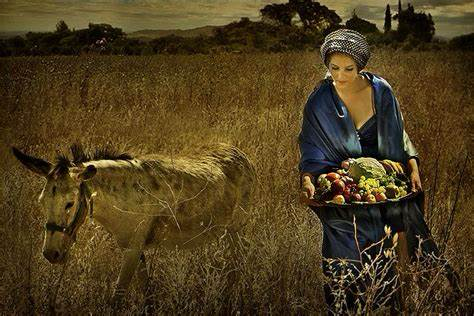
Abigail heard about what Nabal did and immediately had her servants prepare a package filled with loaves of bread, raisin cakes, figs, fruits and wine. She headed out to meet David first, to ask forgiveness for Nabal’s offenses, by bringing David a peace offering of food and wine for him and his men. 

David’s high calling to be the next king, was overshadowed by his frustrations of living as a fugitive. While waiting for certain doors to open in our lives, or for our dreams to be realized, it’s during the hardest times that we may gain the most valuable wisdom. The best character building lessons come during the tests and trials in the waiting stage of our journey. 

When Abigail met David, she dismounted from her donkey and bowed down before him, asking forgiveness for her foolish husband. Abigail had remarkable wisdom and patience, and her peace offering caused David to pause. Then she gently reminded him of his higher calling, and that his kingdom will be a lasting one. Abigail persuaded David to trust in God, and not tarnish his soul or taint his calling, by taking revenge and shedding blood.

She redirected David to his more noble nature, encouraging him to trust in the Lord, instead of acting on  impulse. Her gift of calming words brought peace and wisdom, and she prevented David from needlessly shedding blood. He was touched by her insight, and turned from his wrath. As a result, David rescued himself from himself. There will be times when everyone, in some way,  needs to rescue themself from themself.

God spoke to David through Abigail, to leave everything in His hands. Soon after, Nabal died of a stroke, Saul eventually died in battle, and David was finally crowned King of Israel. Abigail’s intelligence led her to trust in God, speak with wisdom and be a peacemaker. God blessed her later by making her a queen, when King David returned to Carmel and proposed marriage to her.

We may not be called to be kings or queens, but we are all called to be ambassadors for Christ and peacemakers in this world. Like Abigail, we are His messengers, certified by our baptism, to bring His peace to the world in whatever way we are called to do so. 

(2 Corinthians 5:20)

We will probably encounter many Nabals in our lifetime, and some will challenge our patience more than others. Like David, our dreams may be delayed or put on hold, by some unpleasant people or circumstances, but God will fulfill His plans and promises in His perfect timing. 

Abigail teaches us to look at the whole picture, reminding us that we all have a higher calling. The Holy Spirit leads us all to our more noble side, calling us to be peacemakers, as Jesus said, 

“Blessed are the peacemakers, for they will be called children of God.”

(Matthew 5:8)

Lord, help us to see the bigger picture in every situation, and to focus on our higher, more noble calling, as your Spirit leads us in wisdom, to be His peacemakers in this world. Amen

Overcomers

“For everyone born of God overcomes the world. This is the victory that has overcome the world, even our faith.”

1 John 5:4 (NIV)

My mother passed away seventeen years ago, peacefully in her sleep, at the age of 92. Three years ago, I learned that one of her dearest friends passed away at the age of 102. Although I learned of Elsa’s death too late to attend her funeral service, her family recorded the whole service on a You Tube video.

I watched the funeral video and as I listened to each of her relatives give a touching eulogy, it was obvious that she had a wonderful life, surrounded by family and friends, for her 102 years. In my personal memories of Elsa, I’ll never forget that she had numbers permanently stamped on her forearm. 

Elsa grew up in Europe, in a religious Jewish family, but she was sent to a concentration camp either in her teens or early twenties, during the Holocaust. She alone survived among her immediate family, who were all killed by the Nazis. I cannot recall the details of how she finally escaped, but somehow she safely emigrated to America, after the terrible suffering of her early life. 

Eventually, Elsa married, had a family and lived a long, fulfilling life here. In watching her family’s eulogies on You Tube, I found it unusual that not one of the eulogies ever made mention of her experience as a young woman, being in a concentration camp. 

After wondering about the possible reasons, I realized that her early life of suffering was not being ignored, but that the person she had become was so much more meaningful than the tragedy of her earlier life.

It made me aware that we all have  meaning in this world, and we are more than the sum of the tragedies we have overcome. 

Each eulogy described who she was to that particular family member and how much love she brought into their lives. I remember once visiting her in her home years ago, and she repeatedly told me how much she loved and missed my mother, who had passed away. She and my mother worked together for fifteen years, and remained close friends after retirement. 

I didn’t know Elsa as well as my mother did, but I could see that they both had the same resilient, positive attitude, with a very loving spirit. Elsa was there for my mother when my oldest brother, my mother’s first born son, died in a plane crash at the age of 35.

As I listened to the last and final eulogy, I imagined Elsa and my mother having a joyful reunion in heaven. People may go through unspeakable suffering in their lives, but through resilient faith, they become a pillar of strength and love for others. God is able to turn our mourning into joy, with unexplainable graces if we keep trusting in Him. 

Those numbers on her arm were a permanent reminder of the evil that exists in this world, but those numbers didn’t define her, because Elsa lived the rest of her life as an overcomer, not a victim. The person she became during her long life, overshadowed the loss and suffering in her youth. Everyone has the potential to become living examples of God’s lovingkindness, which overcomes evil. 

Elsa received the gift from God to live longer than a century. She overcame with faith, hope and love. She might have been a victim of hatred, but she didn’t succumb to hating. She didn’t live her life as a victim, but rose above it, being kind and loving. Elsa and my mother had totally different faith backgrounds, but they had one thing in common, being overcomers.

God gave each of us the potential to overcome our fear with faith, our despair with hope, mourning with joy, and chaos with peace. Paul wrote, “Do not be overcome by evil, but overcome evil with good.”

(Romans 12:21)

Lord, help every reader to begin this new year as overcomers, filled with your Spirit, reflecting your love and kindness to others through all the days that you have granted us. Amen