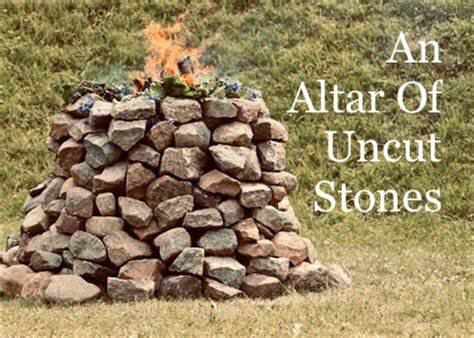
“Then Joshua built an altar to the Lord, the God of Israel, on Mount Ebal, just as Moses the servant of the Lord had commanded the sons of Israel, as it is written in the Book of the Law of Moses, an altar of uncut stones on which no one had wielded an iron tool”.
Joshua 8:30-31 (NASB)
Joshua, who succeeded Moses, built an altar at Mount Ebal, in the manner that Moses commanded. The Lord required that the altar be built with natural stones, meaning uncut, and not hewn with instruments or tools used by human hands.
Occasionally, something we read in scripture is authenticated by what is later discovered by archeologists. The remnants of that altar were found when Mount Ebal was excavated in 2022.
This requirement to offer uncut stones for an altar, is an interesting one, and I wondered if it contains a message of relevancy for us today.
If we come to God as we are, natural and uncut, we are like the unhewn stones that Joshua offered on Mount Ebal.
If we try to change ourselves before coming to God, or if we let others carve and shape us as they want, it makes us pre-hewn, cut or carved with tools. Instead of trying to fix ourselves, or let the world carve us according to current trends, we come to God uncut, just as we are, allowing Jesus to carve us into who He wants us to be.
Abraham is the first example of an unhewn stone, surrendered to God. At the age of 75, God told him to leave his homeland and go to a new land. He believed God, without knowing where he was headed, and his family and friends thought he was crazy. By being an uncut stone, Abraham believed God and was sent on a new mission which brought blessings to many generations who came after him.
Noah also believed God and built an ark, without seeing a single cloud in the sky. God told him that a flood was coming, and he prepared for it, despite the constant ridicule of his neighbors. Noah and his family were like uncut stones, who offered a new beginning for a post flood world.
Hannah was a woman of faith who desperately wanted a child but was barren. Her husband loved her and was content without having children, but she still desired a child, so she went to the temple daily, praying to conceive. The priest noticed her praying with such fervor, that he thought she was drunk, and told her to ‘sober up.’ (1 Samuel 1:14)
Though Hannah was misunderstood by others, God answered her prayer. She gave birth to Samuel, and later dedicated him to full time service in the temple. Hannah was like an uncut stone, and God carved His plan into both Hannah and Samuel’s lives. Samuel grew to become one of the greatest prophets in the Old Testament. He anointed David as king, who became the ancestor to Jesus, the Messiah.
Abraham, Noah and Hannah all yielded to God in a different way, despite the ridicule of skeptics.
It’s just a reminder that we are all a part of something bigger than ourselves. All three of them felt misunderstood and alone at times, but they all left a legacy of blessing to the world, by offering themselves to be carved by God’s divine purpose.
Paul said that we are all meant to yield ourselves to God as living sacrifices. (Romans 12:1) Jesus is the Chief Cornerstone, over His church in the world, and He is always leading us by example.
(Ephesians 2:20)
As Joshua gathered uncut stones, we are gathered by Jesus, carved and hewn by Him, aligning us on the altar of service to God, but it all begins by coming to Him, uncut, just as we are.
Lord, we want to come first to you, uncut, just as we are, to be carved according to your purpose. Make us a light of truth and love that shines throughout this world, so that all people will respond to you. Amen