The strength of hope

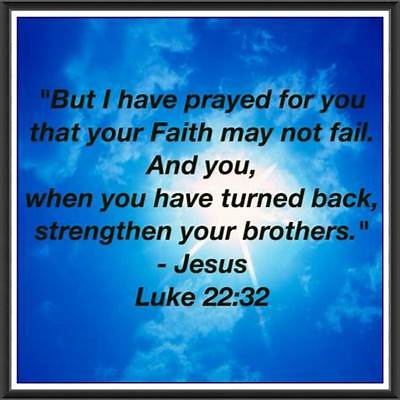
Jesus said to Peter, 

“…but I have prayed that your own faith may not fail; and once you have turned back, you must strengthen your brothers.”

Luke 22:32 (NAB)

Jesus had total confidence in Peter, even though He knew that he would temporarily lose his way. Jesus told Peter that once he turned back, he should go and strengthen his brethren. With Jesus, it was never “if” he would turn back, but “when.”

Everyone can relate to making wrong choices, losing their way and experiencing failure in some way, but even then, God hopes for us to turn back again, because He has total confidence in us. God’s will is for us to return to Him and then to strengthen others in the faith. 

So, instead of dwelling on our past failures, we return to God and with hope, we strengthen others. My two sons had a rebellious period in their early teen years and they both got into trouble with the law. After spending a short time in juvenile detention, they both recommitted their lives to Christ. 

Fifteen years later, my son Michael, met and married a beautiful young Christian woman and today their entire family of four serves the Lord. Michael has shared his personal story with the youth group of his church, in order to strengthen the faith and warn young people against the wrong choices that he made. 

Michael is just another example like Peter, who Jesus told, “After you have turned back, strengthen your brothers.” We learn from our failures, just as a baby learns to walk, by falling several times. We might even learn some of our greatest lessons from our failures, more than from our successes. We are products of our past, but never prisoners of our past. Like Michael, we can use our past errors to strengthen our brothers and sisters in Christ today. 

Learning from our past reminds me of a beautiful true story. There are thousands of orphans in India, and many good people from other nations, who adopt them. It has been said that adopting an orphan means adopting not only the child, but their past as well. 

A five year old boy named Saroo was cared for by an older teenage brother named Guddu, in a small village in India, while their mother did hard labor during the day, just to bring home enough food to feed her children.

One day Saroo’s older brother told him to wait on a public bench as he went to find some work to do. Saroo woke up on that bench in the middle of the night and panicked with no one around. He quickly snuck onto a train, which went straight to Calcutta. The lost five year old wandered all over the streets of Calcutta, as many other orphans did, hungry and sleeping on pieces of cardboard in the streets. He longed for his mother and brother. 

One day as he stared at a man eating a meal in a restaurant, that man later came out and brought Saroo to a police station, to help him find his home. The problem was that Saroo mispronounced the name of his village so no one knew where he was from. To make a long story short, he was placed in an orphanage and adopted by a very kind Australian couple. 

Saroo grew up in a loving home in Australia and finished college, but at the age of 25, he had a restlessness to find his original family in India. He couldn’t help but worry that his mother and brother would have been sick with grief over his disappearance all those years. 

He used google earth to search for the town that he thought he was from, but there was no town called Ganestaly. He kept searching until he found a town called, Ganesha Talai, which turned out to be his home town. 

Saroo went back to India and after speaking to people in his old neighborhood of Ganesha Talai, he finally found his elderly mother living there. It was a beautiful reunion after 20 years. His mother said she had searched for him for so long, but always believing she would see him again. Saroo sadly learned that his older brother, Guddu, had died, but his reunion with his mother was an example of turning back to strengthen others, though it was in a different way than Peter did. 

His Australian adoptive parents were invited to meet his birth mother in India and they were all grateful to have their questions answered. It’s a heartwarming true story of hope, returning and strengthening the hearts of those who lived without answers for so many years. 

Lord, if there is anyone that we can strengthen after turning back in some way, show us. Thank you for the power of hope that lives within us and the faith that brings answers to our prayers. Amen

The ways of His kingdom

“Taking the five loaves and two fish and looking up to heaven, he gave thanks and broke the loaves…..The number of those who ate was about five thousand men, besides women and children.”

Matthew 14:19, 21 (NIV)

This is an example of kingdom math, by the multiplication of the five loaves and two fishes, which fed 5,000 people, as recorded in the gospels. Kingdom math tells us that 5+2=5,000, instead of seven. It’s a math that defies all human calculations and takes our faith to a new level. It inspires us to look beyond the usual sources for the needs of daily living, and to trust God even when the numbers don’t add up. 

Kingdom math is driven by the principle that God multiplies whatever we give to Him. It teaches us to give first, and it will be given back to us. If we give in good measure, pressed down, shaken together and running over, God promises to use the same measure and give it back to us, in abundance. (Luke 6:38)

Another principle of kingdom math is that where sin increases, grace much more abounds.(Romans 5:20) God’s grace increases depending on how much sin needs to be forgiven. 

As long as we keep coming to Jesus, His grace will always be greater than our sin. It makes no human sense, but it’s a Kingdom concept. 

Kingdom logic declares that the first will be last and the last will be first. It also says that those who save their lives will lose it, and those who lose their lives will save it eternally. Tertullian, the third century historian, once said that the blood of the martyrs is the seed that multiplied the church throughout the world. It may not sound logical, but that too is  Kingdom logic, which is not from this world.

The scripture says, “While we were yet sinners, Christ died for us.” It means that Jesus knew us and died for us before we ever knew of Him or believed in Him. He loved us first, so it wasn’t based on our merit, but on His merit and His lovingkindness. Nothing can or ever will separate us from that kind of love. 

Finally, there is the concept of Kingdom fatherhood. Jesus taught us the story of the prodigal son, who went straight from the pigpen into his father’s arms. The father of the prodigal received his son with open arms, although his boy was wearing filthy clothes, and smelled like a pig. He never told his son to go wash himself and change his clothes first. Instead, he embraced him, called for the finest robe to be placed on him, and then threw him a party. 

Jesus told us this parable to teach that whoever comes to His Father, is accepted, celebrated, clothed in a robe of righteousness, and greatly loved, all because of the atoning blood of Christ. There is not a more powerful example of God’s grace than the parable of the prodigal son. 

Paul wrote, “Love bears all things, believes all things, hopes all things, and endures all things.” It’s the nature of God to love, bear and keep hoping for us, through all things. (1 Corinthians 13:7)

Kingdom math, Kingdom logic and Kingdom fatherhood are not from this world. They are all motivated by God’s love and grace, and not dependent on our worthiness. We could never earn this kind of love and grace, because it’s God’s most cherished gift to us.

Lord, thank you for loving us and revealing your Kingdom ways, as you taught us in the gospels. We trust your ways in every part of our lives, and our aim is to always follow you more intimately. Amen

A toddler’s face of mercy

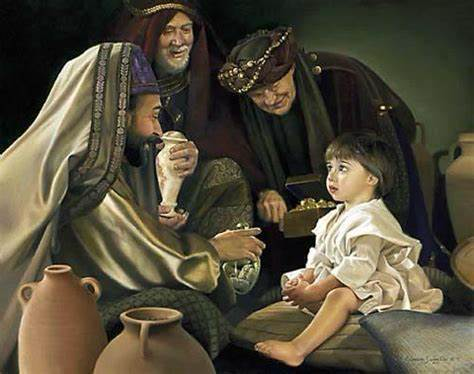
“…and on entering the house they saw the child with Mary his mother. They prostrated themselves and did him homage. Then they opened their treasures and offered him gifts of gold, frankincense, and myrrh.”

Matthew 2:11 (NAB)

I believe that the story of the magi has meaning for us every single day. The Magi came to worship a divine king, who was two years old by the time they arrived. The gospel tells us that they entered “the house” to see the child. So Jesus and his parents were living in a house by the time the Magi arrived.

According to the catacomb paintings and early historians, there were more than three magi, possibly twelve. They were not kings, but advisors to kings, and they came from the East, in what would be present day Iran and Iraq. They were from a completely different culture, educated in mathematics, science, medicine, astronomy, astrology, prophecy, and even magic. They knew the Hebrew prophecy of a divine child to be born, which correlated to the astronomical sign in the sky, and it led them to the house where that toddler king was living. 

Jesus, even at two years old, touched the hearts of those who were outside the margins of His family’s religious community. God had a purpose in leading such a unique group of learned men from the East to visit a poor Hebrew toddler, who wasn’t even old enough to converse with them. What could a two year old boy offer these wise men?

The Magi never heard a parable or a single sermon. They never saw a miracle or witnessed His divine power, and yet they came to bow in worship and offer their gifts to Jesus. They only knew that this toddler was the Son of God and Savior of the world. What made them true “wise men” was that they came to Jesus, to receive the greatest gift of all, the honor of His presence. 

The Magi teach us the greatest lesson of the Season, which is to seek His presence above all else. They travelled a long way just to worship Jesus and bring Him their gifts. God didn’t lead them there to increase their knowledge, grant them more wisdom or correct the errors of their belief. He led them there to bless them with the presence of His Son.

The prophet Jeremiah said, “You will seek me and find me; when you seek me with all your heart.” (Jeremiah 29:13)

The Magi sought with all their hearts for the Messiah child king.  Every sincere searcher is going to inevitably be led to a revelation of Jesus. In the presence of that little toddler, they beheld the face of God’s mercy. 

Years later, people beheld the same face of mercy as Jesus taught, prayed, touched, ate, drank and performed many miracles among them. A dying thief beheld His face of mercy as he hung on a cross next to Him, which led him straight to Heaven. 

The entire life of Jesus was directed at finding the lost sheep among His own community as well as those outcasts among the margins of society. Many gladly encountered His face of mercy, and found that His grace extends far beyond cultural, ethnic and racial boundaries.

The Magi happened to be the first group of outsiders, to be blessed by seeking His presence and discovering His face of mercy. 

Lord, may we always envision you as the face of mercy, in all situations. We worship you in this season of your birth, and seek your presence as the greatest gift of all. Amen

Hope realized

“After his suffering, he presented himself to them and gave many convincing proofs that he was alive. He appeared to them over a period of forty days and spoke about the kingdom of God.”

Acts 1:3 (NIV)

Jesus fasted and was tempted in the desert for 40 days, but on day 41, the devil departed from Him. He appeared to many people after His resurrection, over a period of forty days, and then He ascended back into Heaven.  The early church was formed on that 41st day, when Jesus left this world, entrusting His church to spread the good news about Him. 

Forty is a pretty special number throughout scripture. It represents a time of testing or suffering. I have always been fascinated by God’s choice and use of numbers, and after 40, comes the number 41, representing hope realized. 

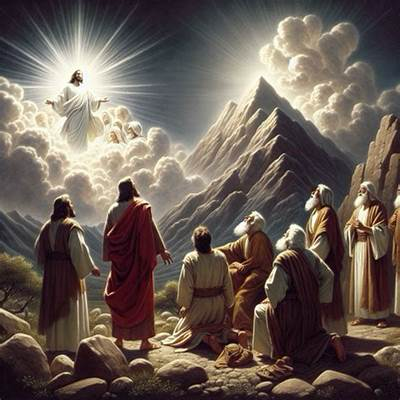
The number 40 is repeated throughout the old and new Testaments. In the days of Noah, it rained for 40 days and 40 nights, but on day 41, the rain stopped and a rainbow appeared. Moses left the Egyptian palace in fear, living as a shepherd in the land of Midian for 40 years, but in the 41st year, he was called to lead the Israelites out of slavery. Moses spent 40 days on top of Mount Sinai overshadowed with fire, smoke and lightning, but on day 41, he came down from the mountain bringing with him the ten Commandments.

Goliath taunted Israel for 40 days, but on day 41 he was slain by David. Jonah preached a message of repentance to the people of Nineveh for 40 days, and on day 41, the entire city believed and was saved. The Israelites wandered in the wilderness for 40 years, but in year 41, they finally entered their Promised Land.

There are so many other bible stories involving the number 40, there isn’t room to write about it. 

The number 40 may represent a time of testing and trials, but it also has a deeper meaning that sends a message of hope to us through all these examples, saying, 

“Don’t give up, 41 is coming!”

It’s a number that reminds us to never stop believing, never give up hope, and to keep our eyes on Jesus, instead of our dilemma, because He always has a word of encouragement for us in the midst of our fiery trials and storms. 

The giants will fall, the rainstorm will stop, the devil will flee, the lost will be found, and God will lead us out of our desert and into the promised land. However bleak the world appears at times, we know that 41 is coming. Our living hope is Jesus, and just as He left this world on the 40th day after His resurrection, He is coming back again in the same way.

Lord, because you live, we live also. Renew our hope so that whatever we go through, we may know that you meant for us to be over comers, through your peace, love and joy. Amen

Touch me and see

“Jesus said to him, “Everything is possible to one who has faith.” 

Then the boy’s father cried out, 

“I do believe, help my unbelief!”

Mark 9:23-24 (NAB)

Faith is knowing that everything is in God’s hands, even when things seem to be getting worse. As our faith weakens, it’s okay to come honestly to Jesus and say, 

“Lord, help me in my unbelief.” 

Those were the words of the father of a demon possessed boy. He barely had faith to believe that his son could be delivered, but He came to the right person. Every miracle begins by coming to the right person, who is Jesus. 

When the father of that boy heard Jesus say, “anything is possible to the one who believes”, he figured that excluded him. He had very little hope, but a lot of honesty, when he said to Jesus, “Help me in my unbelief.” 

It’s easy to get the impression that Jesus only responds to people of great faith. He praised the Centurion who said “Only say the word, Lord.” He was impressed by the woman who said “If I can just touch the fringe of His garment.” 

He highlighted the example of the gentile woman who humbly persisted in faith, saying, “Even a dog can receive the crumbs that fall from the table”. 

There’s no doubt that the Lord responds to great faith, but He also responds to great honesty. Jesus was touched by that desperate father’s honest plea, “Help me in my unbelief, Lord.” Jesus is looking for an intimate relationship with us, and intimacy requires honesty. Scripture shows us that God loves a heart open to Him in truthfulness.

Jesus wanted to help those who were struggling to believe that He had truly risen on that third day. He made an effort to convince His disciples that His body was risen, and He wasn’t merely a ghost or a spirit. He asked for something to eat and ate food in front of them. He showed them His scars and His wounded side. 

He went as far as to offer all of the disciples, not just Thomas, to touch Him and feel His scars, saying, 

“It is I, myself. Touch me and see; a ghost does not have flesh and bones, as you see I have.” 

(Luke 24:39)  

God is patient with everyone who is struggling to believe for something. He was patient with the father in this story, He was patient with His disciples, and He is equally patient with us today. He doesn’t expect us to fake it and pretend we believe, or to walk away in unbelief. We learn from the father in this story that there is a third option, to ask Jesus to help us in our unbelief. 

I don’t always have confident faith and assurance when I pray for my son, Jon. I frequently need to ask for help in my own unbelief. Then I try to visualize Jesus’ nail scarred hands extended towards me, telling me to touch Him and see. He never scoffs at us in our doubts. What a comfort it is to have a Savior, who accepts and loves us as we are. 

As we recall God’s unconditional, relentless love for humanity, and all the various levels of faith among His believers, we can almost hear Him saying to us today, 

“Touch Me and see how much I love you.”

Lord, whatever level our faith is at, help us to remain intimate and honest with you, as you help us in times of unbelief. As we touch you by faith, draw us closer and deeper in devotion to you. Amen

Faithful to the faithless

“But you, Lord, are a compassionate and gracious God, slow to anger, abounding in love and faithfulness.”

Psalm 86:15 (NIV)

Mostly every prophet in the Old Testament speaks of a gracious and slow to anger God, who does not forsake us, even when His people behave in arrogance and unbelief. Nehemiah describes His people as stiff-necked and rebellious, and yet God is forgiving, gracious, slow to anger and abounding in love, who never deserted them.(Nehemiah 9:17) 

David described a loving God who forgives the arrogant and shows abundant mercy to the morally fallen or faithless. David simply wrote about what he himself experienced, after falling into sin, and later repenting and receiving God’s abundant mercy. 

Zechariah foretold of a fountain of mercy that would come to all people through the house of David and cleanse them from sin. Jesus, a descendant of David, is that fountain of mercy, forever. 

Isaiah said that although our sins are red as scarlet, they shall be white as snow. (Isaiah 1:18)

What kind of a God so patiently pursues people, to cleanse and restore them, despite their flaws and faithless moments?

The answer is: a God who is worthy for us to entrust every part of ourself to Him. 

I recently heard a true story about someone who experienced this kind of mercy and forgiveness. I am a super fan of the Chosen movie series, and recently heard a TV interview with the actor, Nick Shakour, who plays the role of Zebedee, the father of James and John, in the Chosen movie series. 

Nick was chosen for the role before he was a believer. He grew up in Lebanon, the grandson of a Greek Orthodox priest, but over the years of tragedy and loss that he and his family witnessed in that war torn country, he grew bitter and angry, eventually losing his faith in God. 

The day Nick accepted the role as Zebedee, for the faith based movie series, he told God, “I am going to do this, but I really don’t believe you exist.” We might expect that God would reject or turn away from someone who spoke that way to Him, but God is faithful even when we are faithless.  (2 Timothy 2:13)

God isn’t thin skinned or easily driven away by the arrogance and unbelief of people. He knows everyone’s personal story and has relentless love and patience beyond our comprehension, and He never stops pursuing them. 

There were two construction crew workers on the movie set of the Chosen, who were Christians and felt strongly led by the Holy Spirit to approach Nick one day and invite him to a big prayer meeting event. Nick was reluctant, but he went, just to please his coworker friends, yet he expected to react with cynicism.

At that prayer conference, people who Nick never knew or saw before, came up to him and laid hands on him to pray. He felt a compelling and powerful presence of the Holy Spirit working deep within him. He started to feel an urge to release the anger that had controlled him for so long. He gave up his anger by surrendering his life to Christ at that prayer event.

In that moment, Nick had a personal encounter with Jesus, realizing how much God, his Father, has always loved him, and he was totally changed from that day onward. Nick now has a hunger to spend as much time with Jesus as possible. He shares his story on various Christian TV shows. His life has changed so dramatically that he holds back tears whenever he shares his story. 

Nick is just one example of millions of people who have come to know a God of relentless mercy, patience, love and forgiveness. We serve a God who is forever faithful, even if we are faithless. 

Lord, thank you for being such a merciful, loving and ever faithful God. Give us more of your love and patience and change the hearts of our friends and relatives who are not believers, so that they may also know your mercy. Amen 

A sign from God

“When the angel of the Lord appeared to Gideon, he said, “The Lord is with you, mighty warrior.”

Judges 6:12 (NIV)

I often ask God to give me a sign that He is with me, that all will be okay, when I have to undertake a difficult task, a new responsibility, or have a new medical procedure to go through. Asking for a sign doesn’t indicate lack of faith. 

God doesn’t have an ego that gets bruised if we ask for a sign. A sign may even increase our faith. So I looked at what scripture teaches on the subject. 

The book of Judges was during a time period when the Israelite tribes were severely impoverished by the Midianites. They were destroying their crops, season after season, reducing them to utter poverty, until the Israelites cried out to God for help. God heard their cry and sent an angel to call the man He chose to lead Israel to victory over their oppressors. 

The angel appeared to a young man named Gideon, and greeted him, “The Lord is with you, mighty warrior.” At that moment, Gideon was in the middle of threshing wheat for his family. He never considered himself mighty, much less a warrior, and was alarmed to be addressed as such. Gideon  considered himself to be a nobody. He was from the poorest of families, being the least promising one in his family, and was from the half tribe of Manasseh, the least among the tribes of Israel. 

Yet, the Lord said to Gideon, “Go with the strength you have, and save Israel from the power of Midian. Is it not I who send you?”

(Judges 6:14) 

Since Gideon was still insecure, he asked God to give him a sign, that He would be with him to accomplish the task. To make a long story short, God gave Gideon a sign, which involved instantly wetting a fleece that was dry, and then instantly drying it when it was wet. 

Gideon felt confident with the sign God sent through the fleeces. He gathered a few hundred brave men and defeated the massive Midianite army of thousands. I decided that if God was willing to send a sign to Gideon, in His great compassion, He may also give us a sign if we ask for it. So I asked.

Prior to a scheduled epidural steroid injection in my spine for  sciatic pain, I asked friends to pray for a successful injection, and I also prayed for God to give wisdom and skill to the neuroradiologist who gives the injection. 

On the day of the injection, I thought of other times that God gave me signs. Recalling the story of Gideon, I believed that He could and would give me a sign. Before I left the house I said, “Lord, I ask for a sign that you are with me in this procedure, but even without a sign, I trust you anyway.”  

While sitting in the waiting room of the department, watching patients being called into a room one by one, by different X-ray techs, I wondered if I would see anyone I know, since I’ve been retired for two years, and from a totally different department. 

Finally, my name was called by an  X-ray tech who was assigned to prepare me for the procedure. I looked up and it was Mohammad, someone I had worked with in the operating room for over 20 years. We were pleasantly surprised to see each other and met with a hug. 

Of all the people who did X-rays in the operating room, there was not a person of more exceptional moral character, decency and kindness, than Mohammad. He is such a good man, that I used to be moved by maternal instinct, to pray that God would send him a wife. 

In realizing how God’s perfect timing lined me up on the exact day, at the precise time, with him, who was sent to prepare me for my injection, I knew in my heart, this was the sign from God that He is with me. 

Any other X- ray tech would have been capable, but it would not have been a sign from God. The Lord sent Mohammad, who I not only knew and worked with for many years, but someone whose character I always admired. That was my sign. 

God is with us whether we get a sign or not, but when He sends us a sign, it’s a gift. His signs usually involve people, timing and places that all come together at a special moment, if we are aware of it. My  pain is already decreased and I am having better nights of sleep without pain. 

As we pray and trust, like Gideon, we go in the strength we have, and God is always with us. He will walk with us through any task, and since He is a good Father, He always hears us and gives His children the sign we need, when we ask for it. 

Lord, help us to see ourselves as you see us. Give us a sign so we  be mighty warriors through our prayer, faith, acts of kindness and in reflecting your love to others.

Amen